
“Ma’am, I’ve stopped eating roti completely for the last two months.”
I hear some version of this sentence at least three times a week in my clinic. It’s usually said with a mix of pride and exhaustion — pride because the client thinks they’ve finally cracked the code on weight loss, exhaustion because two months of dinner salads have left them tired, irritable, and, more often than not, barely any lighter than when they started.
So let’s settle this properly, because in twelve years of practice and over 5,000 client consultations across Delhi NCR, “Should I give up roti?” remains the single most common question I’m asked — more than questions about exercise, more than questions about supplements.
The short answer is no. The more useful, longer answer is what this article is about.
Is Roti Really the Reason You’re Not Losing Weight?
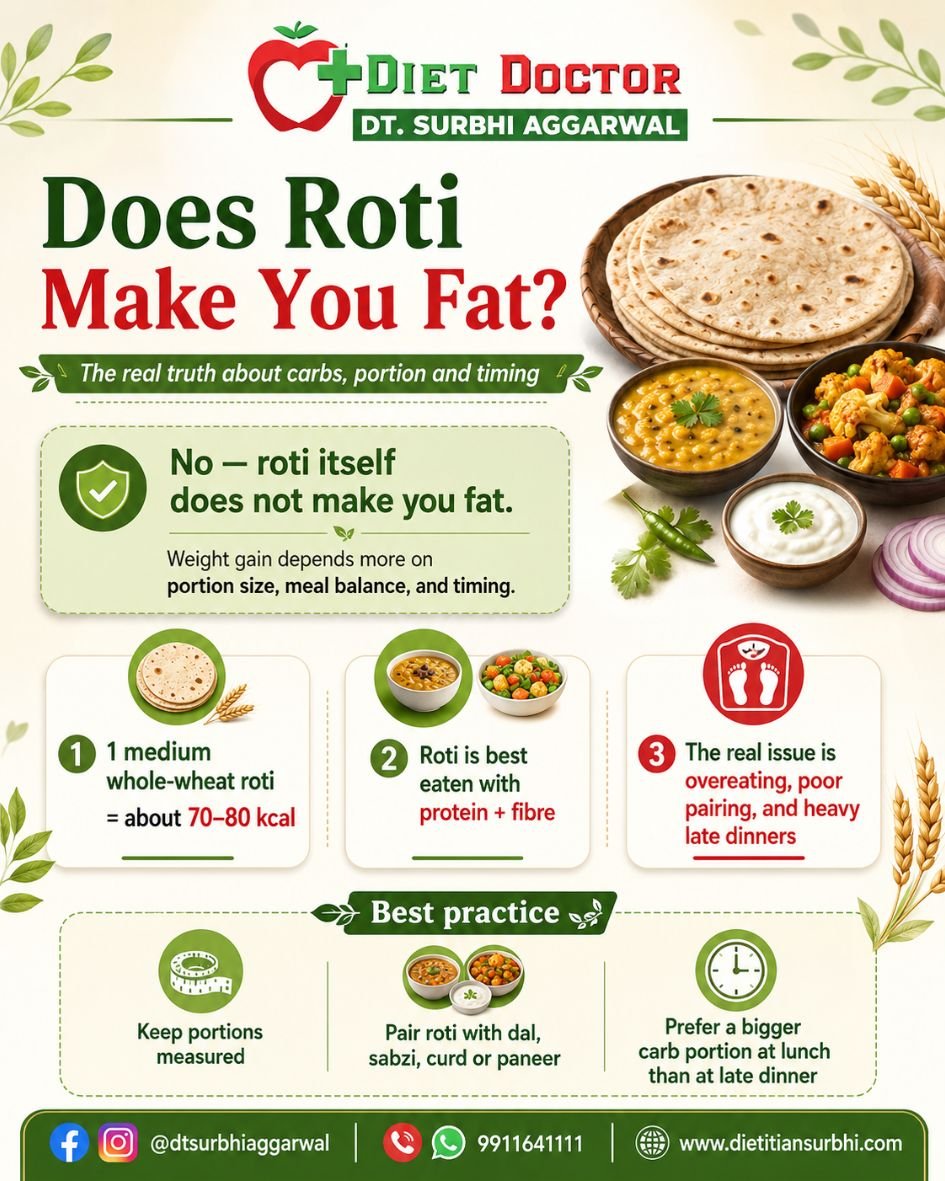
A medium roti made from whole wheat atta is roughly 70-80 calories — similar to a small bowl of rice, and far less than most people assume when they picture “carbs.” The issue was never really the roti sitting on your plate. It’s usually what’s next to it, how much of it you’re eating, and when you’re eating it. This is the foundation of every personalized weight loss plan I build for clients — fixing the variables around the roti, not removing the roti.
What the Glycemic Index of Roti Actually Tells You
You may have read that roti has a “high glycemic index” and should be avoided. That’s only half the story.
The glycemic index (GI) — a concept developed by Dr. David Jenkins and colleagues at the University of Toronto in the early 1980s — measures how quickly a food raises blood sugar when eaten alone. Whole wheat roti made from chakki-ground atta sits in the medium GI range on its own. But almost nobody eats roti by itself. Pair it with dal, sabzi, curd, or paneer — all of which slow digestion and blunt the blood sugar spike — and the glycemic load of your actual meal drops considerably.
This is also why I rarely recommend white-flour (maida) rotis, naan, or bhature as a daily habit. Refined flour behaves very differently in the body compared to whole, unrefined wheat.
Portion Size: The Variable Almost Everyone Skips
This is where most clients who come to me have actually gone wrong — not with roti itself, but with how much of it lands on the plate.
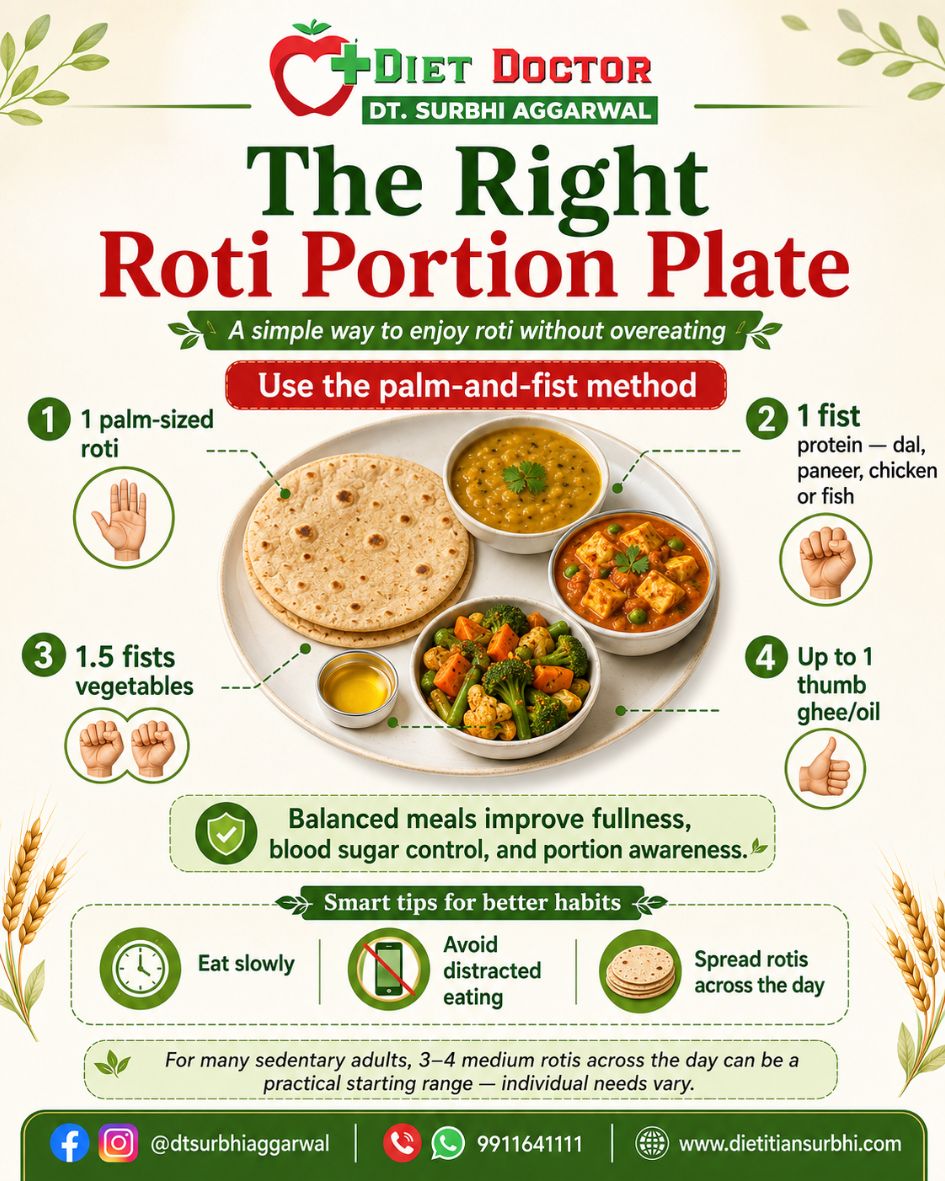
A standard medium roti, roughly palm-sized, fits comfortably into most weight loss plans. The trouble usually starts when “two rotis” quietly becomes four, especially at dinner, when we’re eating distracted in front of a phone or TV. The National Institute of Nutrition (ICMR-NIN), which publishes India’s official dietary guidelines, recommends that cereals and millets continue to form a substantial share of daily energy intake for healthy adults — the guidance has never been to eliminate them, only to balance the portion against your activity level and the rest of your plate.
In consultations, I rarely ask clients to count calories obsessively. Instead, I teach the palm-and-fist method: a roti portion roughly the size of your palm, vegetables filling a fist-and-a-half, protein (dal, paneer, chicken, or fish) about a fist, and no more than a thumb’s worth of ghee or oil for the whole meal.
Timing Matters More Than the Roti Itself
The second variable nobody talks about is when you’re eating your carbohydrates.
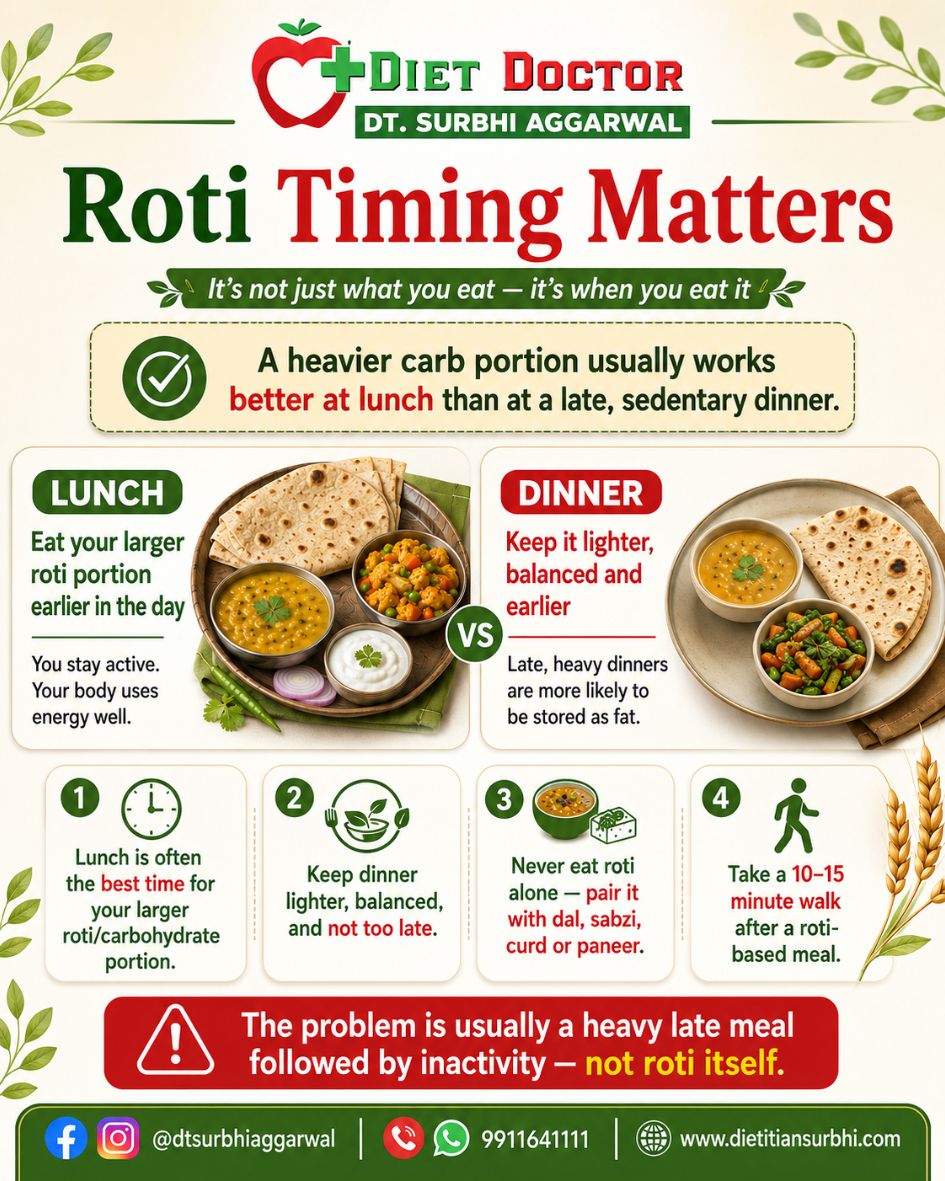
Insulin sensitivity is naturally higher earlier in the day and tends to decline by evening. That doesn’t mean dinner roti is forbidden — it means your largest carbohydrate portion is generally better placed at lunch, when you’re more active afterward, rather than as a heavy meal eaten late and followed immediately by sleep. I also encourage clients to never eat a carbohydrate in isolation. Roti with just achaar isn’t a complete meal; roti with dal and sabzi is — the protein and fibre slow absorption and keep you fuller for longer.
What Happens When You Cut Out Roti Completely
This is the pattern I see most often, and it’s worth understanding before you try it yourself.
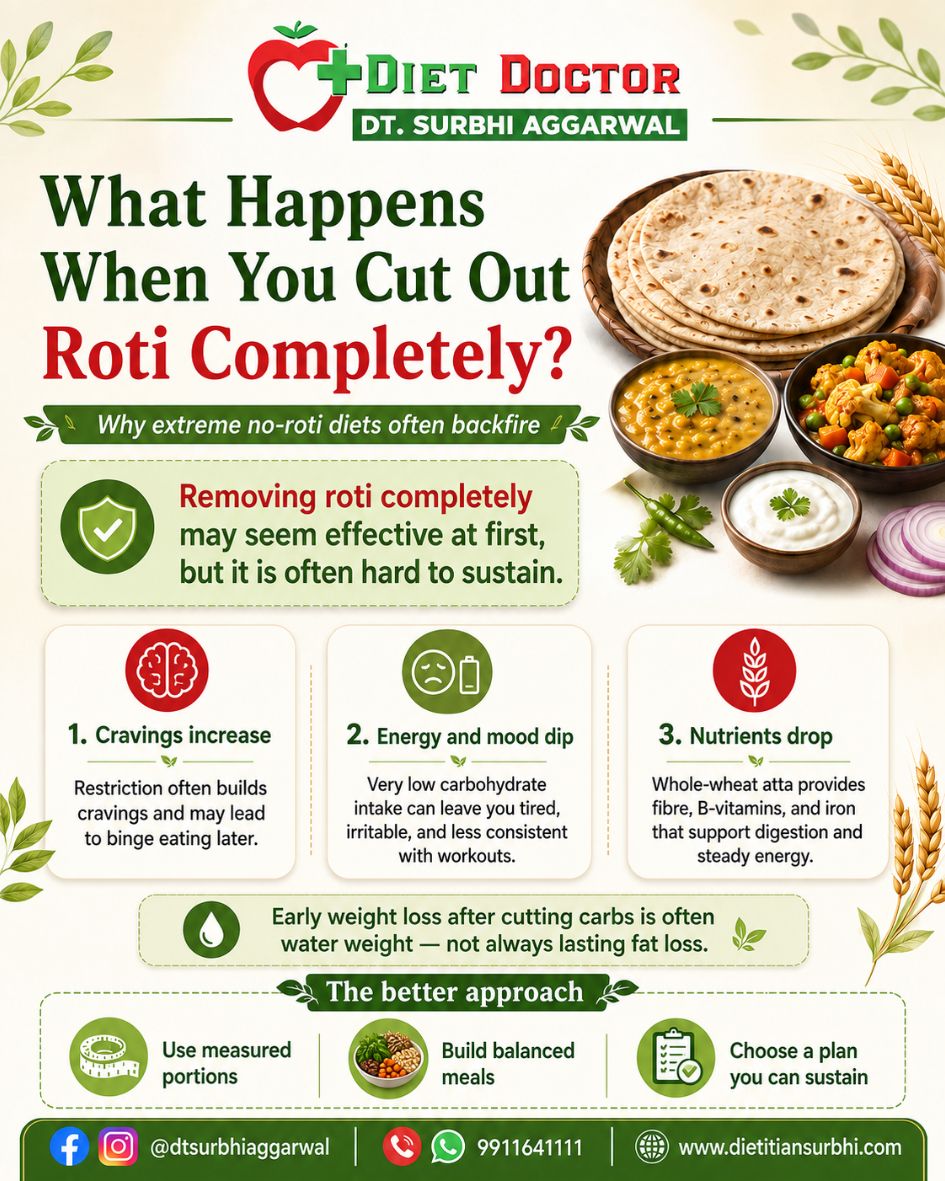
When clients eliminate roti entirely, three things tend to happen:
- Cravings build up, usually peaking around day 10–14, often ending in a binge that undoes a week of “discipline” in one sitting.
- Energy and mood dip. The brain relies heavily on glucose, and a sharp drop in dietary carbohydrate can leave you flat, irritable, and unable to sustain workouts or focus at work.
- You lose the fibre, B-vitamins, and iron that whole wheat atta naturally provides — nutrients that matter for digestion and steady energy, especially in vegetarian households across North India.
None of this means willpower was the problem. It means the plan was unsustainable from day one. This is exactly why strict no-carb approaches tend to collapse by month two — and why nearly every client who comes to me after trying one has regained the weight, sometimes with a few extra kilos added on. If this sounds familiar, my piece on the 30-Day Ghar Ka Khana Reset walks through how to rebuild a sustainable plan after a crash diet like this.
The Right Way to Eat Roti for Weight Loss
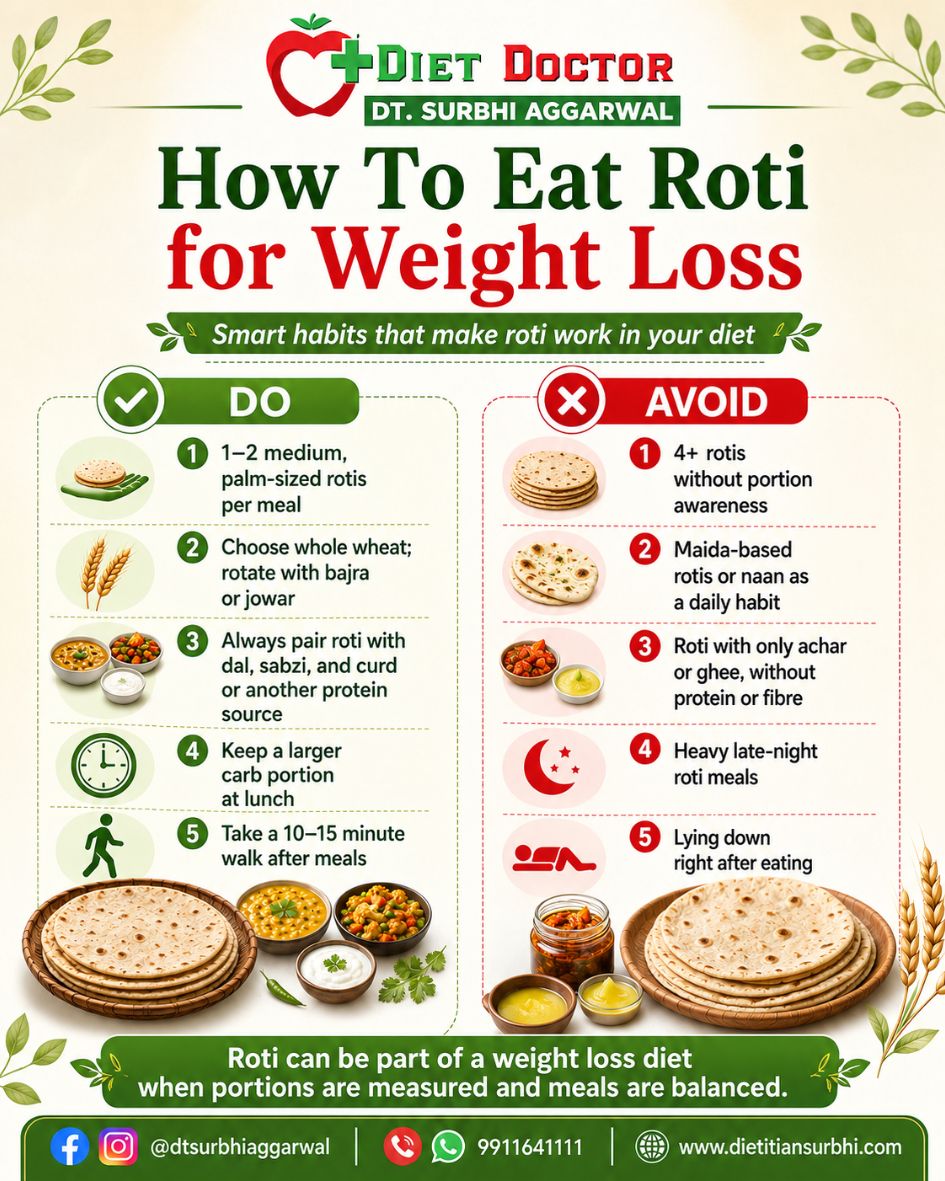
Here’s the framework I actually give clients at my Punjabi Bagh and Model Town clinics — the same one I send to online clients across India, the US, and the UK.
| Do | Avoid |
|---|---|
| 1–2 medium, palm-sized rotis per meal | 4+ rotis eaten without any portion awareness |
| Whole wheat (chakki atta), rotated occasionally with bajra or jowar | Maida-based rotis or naan as a daily habit |
| Roti with dal, sabzi, and curd, every time | Roti with only achaar or ghee, no protein or fibre |
| Larger roti portion at lunch | Heaviest roti portion at a late, sedentary dinner |
| A 10–15 minute walk after a roti-based meal | Lying down immediately after eating |
A simple example: one roti, a katori of dal, a katori of sabzi, and a small bowl of curd at dinner is a complete, blood-sugar-friendly meal — not a “cheat.” For more structured ideas, my Custom Indian Meal Plans are built around exactly this kind of balanced plate.
What I See in My Clinic
A 34-year-old marketing professional from West Delhi once came to me after cutting out roti completely for eight months. In that time, she had gained close to four kilos, alongside constant fatigue and sugar cravings every evening by 6 PM. We didn’t remove anything else from her plate — we simply brought back one measured roti at lunch, trimmed her dinner carbohydrate portion, and added protein to her breakfast. Within six weeks, her evening cravings had largely disappeared, and her weight had started moving in the right direction again — while she was eating more food, not less. This isn’t an unusual story in my practice. It’s closer to the rule than the exception.
Frequently Asked Questions
Does eating roti at night cause weight gain?
Not on its own. What matters more is portion size and what you pair it with. A single measured roti with dal and vegetables at dinner is unlikely to cause weight gain. The bigger risk factor is a large, carb-heavy dinner eaten late with no activity afterward.
Is rice better than roti for weight loss?
Neither is inherently “better.” Both are carbohydrate sources, and the right choice depends on portion control, what you pair them with, and personal preference. I generally suggest picking one as your primary carbohydrate at a meal rather than stacking large portions of both together.
How many rotis should I eat per day to lose weight?
This depends on your body weight, activity level, and overall calorie needs, which is why a personalized assessment matters. As a general starting point for a sedentary adult aiming to lose weight, 3–4 medium rotis spread across the day — rather than concentrated at one meal — is a common, sustainable range, adjusted up or down based on individual factors.
Should I switch to multigrain or millet roti instead of wheat?
Millets like bajra, jowar, and ragi are excellent additions and offer more fibre with a lower glycemic load than refined wheat. You don’t need to eliminate wheat roti entirely — rotating between whole wheat and millet flours often works better long-term than a strict switch.
Why did I lose weight initially by cutting roti, but then plateau or gain it back?
This is a very common pattern. Early weight loss after cutting carbohydrates is often water weight, since carbohydrates are stored in the body along with water. Once the restriction becomes unsustainable, adherence drops, and the weight returns — often with some cravings-driven overeating layered on top.
Can people with diabetes or PCOS eat roti?
Yes, in most cases, with attention to portion, pairing, and timing. If you’re managing diabetes or PCOS, I’d recommend a personalized plan rather than self-restricting, since insulin sensitivity varies significantly from person to person — this is exactly what we build in our Diabetes Reversal and PCOS/PCOD Reversal programs.
Ready to Stop Guessing With Your Diet?
If you’ve spent months giving up roti, rice, or your favourite foods with little to show for it, it might be time for a plan built around your body, blood reports, and lifestyle — not a generic “no-carb” rule.
Book a consultation with Dietitian Surbhi and let’s build a weight loss plan you can actually enjoy eating.
📞 Call/WhatsApp: +91-9911641111