
“Ma’am, I feel so guilty every time I eat dal-chawal. But it’s the one thing that actually keeps me full.”
She’d been on three different “clean eating” plans in the previous year. She’d done no-rice, no-carb, no-this, no-that — and gained weight each time she stopped because nothing was sustainable. She came in apologising for her dal-chawal habit as if it were a confession.
I told her to stop apologising. I told her dal-chawal might just be the most underrated weight-loss meal in an Indian kitchen.
Over twelve years of nutrition practice and more than 5,000 clients later, I’ve seen this pattern more times than I can count. The clients who do best long-term are rarely the ones doing bulletproof coffee or overnight oats. They’re the ones who learn to eat dal-chawal correctly — with the right portions, the right additions, and the right timing.
Let me tell you exactly what “correctly” means.
Why Dal-Chawal Got a Bad Reputation It Doesn’t Deserve
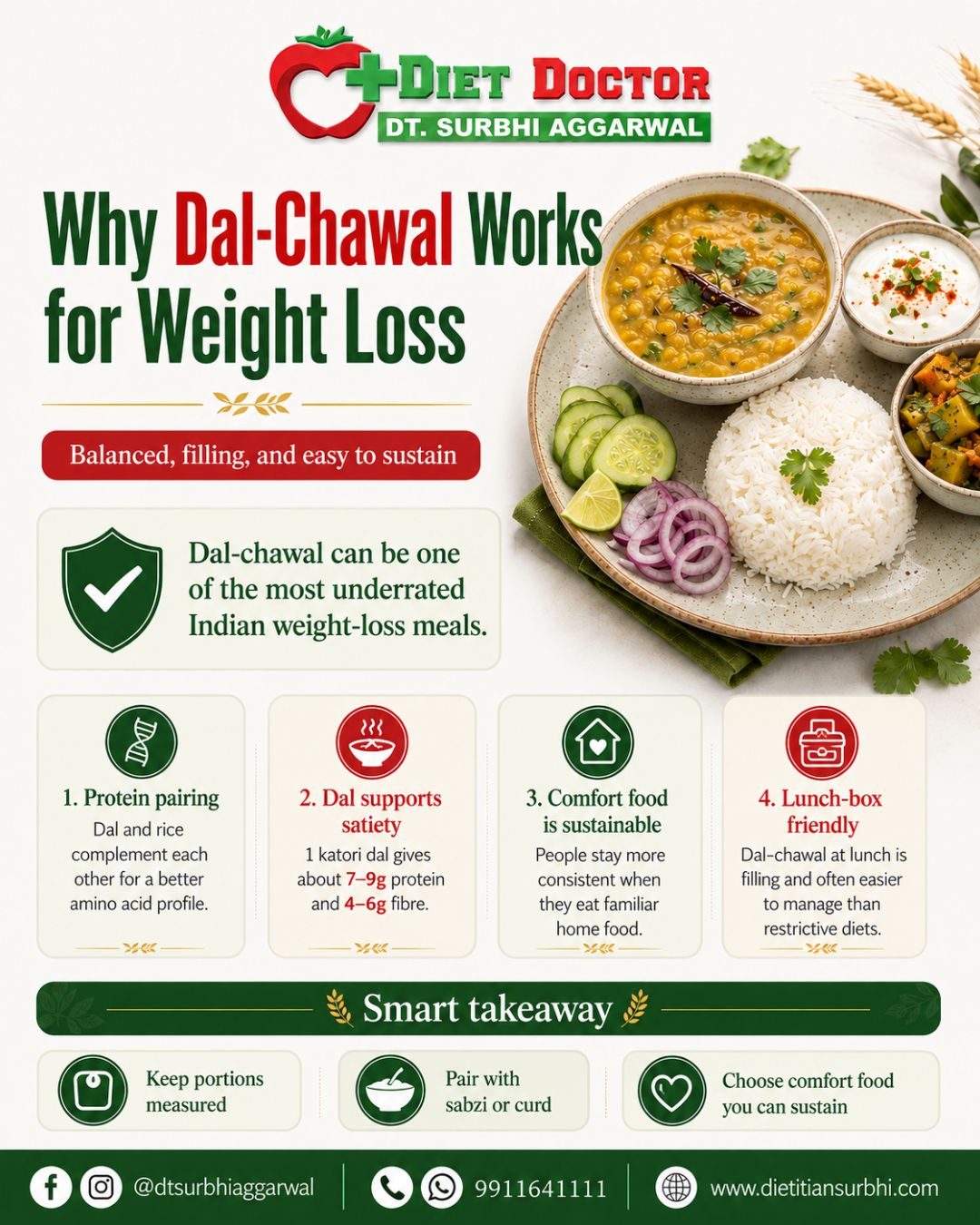
The logic that put dal-chawal in the villain’s chair goes something like this: rice is a carbohydrate, carbohydrates make you fat, therefore dal-chawal is off-limits for weight loss.
Every link in that chain is either wrong or vastly oversimplified.
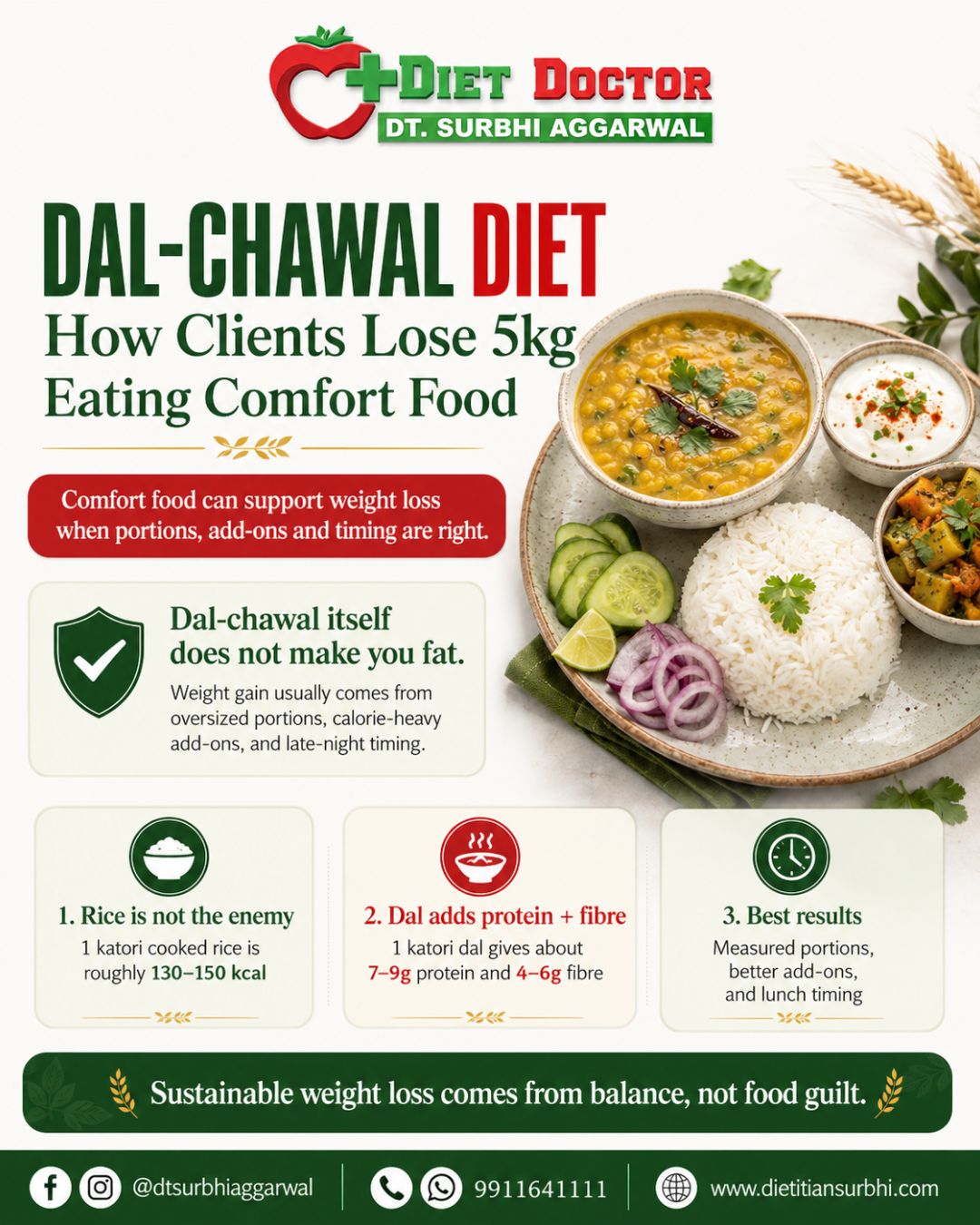
Rice is a carbohydrate, yes. But weight gain is caused by sustained calorie surplus — eating more than your body uses, consistently, over time. A single katori of cooked rice is roughly 130–150 calories. Dal — in whatever form, moong, masoor, toor, or chana — is a source of both protein and complex carbohydrate, and one of the most fibre-dense foods in a typical Indian diet. Together, they make a combination that is filling, balanced, and genuinely supportive of a healthy weight.
The reason some people gain weight eating dal-chawal isn’t the dal-chawal. It’s almost always one of three things: the portion is too large, the accompaniments are calorie-dense (fried papad, excess ghee, heavy subzi), or the meal is eaten very late at night followed immediately by sleep. None of those are problems with the food itself. They’re problems with how the food is being eaten. That’s a meaningful distinction — and fixing those three variables is the foundation of the weight-loss plans I build for clients.
The Nutrition Case for Dal-Chawal
Before we get into portions and timing, it helps to understand why this combination is worth defending nutritionally.
Dal is one of the best plant proteins available in an Indian kitchen
The National Institute of Nutrition (ICMR-NIN), in its Dietary Guidelines for Indians, classifies pulses and legumes as a critical protein source, particularly for vegetarian households. Dal contains a range of amino acids — most notably lysine — that are lower in cereals like rice. Rice, in turn, provides methionine, an amino acid that legumes lack in higher amounts. When eaten together in the same meal, dal and rice offer a more complete amino acid profile than either would alone. This complementary protein effect is one of the reasons dal-chawal has fed Indian families across every economic bracket for generations — not because people didn’t know better, but because the combination genuinely works for the body.
One katori (roughly 150ml) of cooked masoor or toor dal provides approximately 7–9g of protein, depending on concentration, alongside 4–6g of dietary fibre. For a vegetarian client trying to hit protein targets without supplements, dal is a cornerstone food — not a food to avoid.
Rice, when cooked and cooled, behaves differently than you might expect
Here is the detail most diet blogs skip over: when cooked rice is cooled — even slightly, to room temperature or in the refrigerator — a significant proportion of its starch converts into what food scientists call resistant starch. Resistant starch is not digested in the small intestine the way regular starch is. Instead, it passes to the large intestine, where it feeds beneficial gut bacteria and produces fewer calories than regular digestible starch. Research published in food science literature has consistently shown that resistant starch content increases meaningfully when cooked-and-cooled rice is compared to freshly cooked hot rice.
This doesn’t mean cold rice is a magic weight-loss food. But it does mean that dal-chawal eaten at room temperature — the way most people in India eat lunch from a tiffin box — has a lower effective glycemic impact than you’d calculate from a raw nutrition table. Which is one of the reasons my lunch-box clients, who eat dal-chawal from a dabba without reheating it, often report better satiety than those who eat freshly cooked rice piping hot.
The fibre in dal is exactly what most Indian diets lack
Dietary fibre slows digestion, moderates blood sugar response, and extends the feeling of fullness after eating. Most urban Indian diets are well below the recommended fibre intake. Dal is one of the simplest ways to bridge that gap without changing your cuisine. A proper dal-chawal meal, with a katori of dal plus a katori of sabzi, can provide 8–12g of fibre — roughly 30–40% of a day’s target in a single meal.
What Actually Goes Wrong: The Three Real Culprits
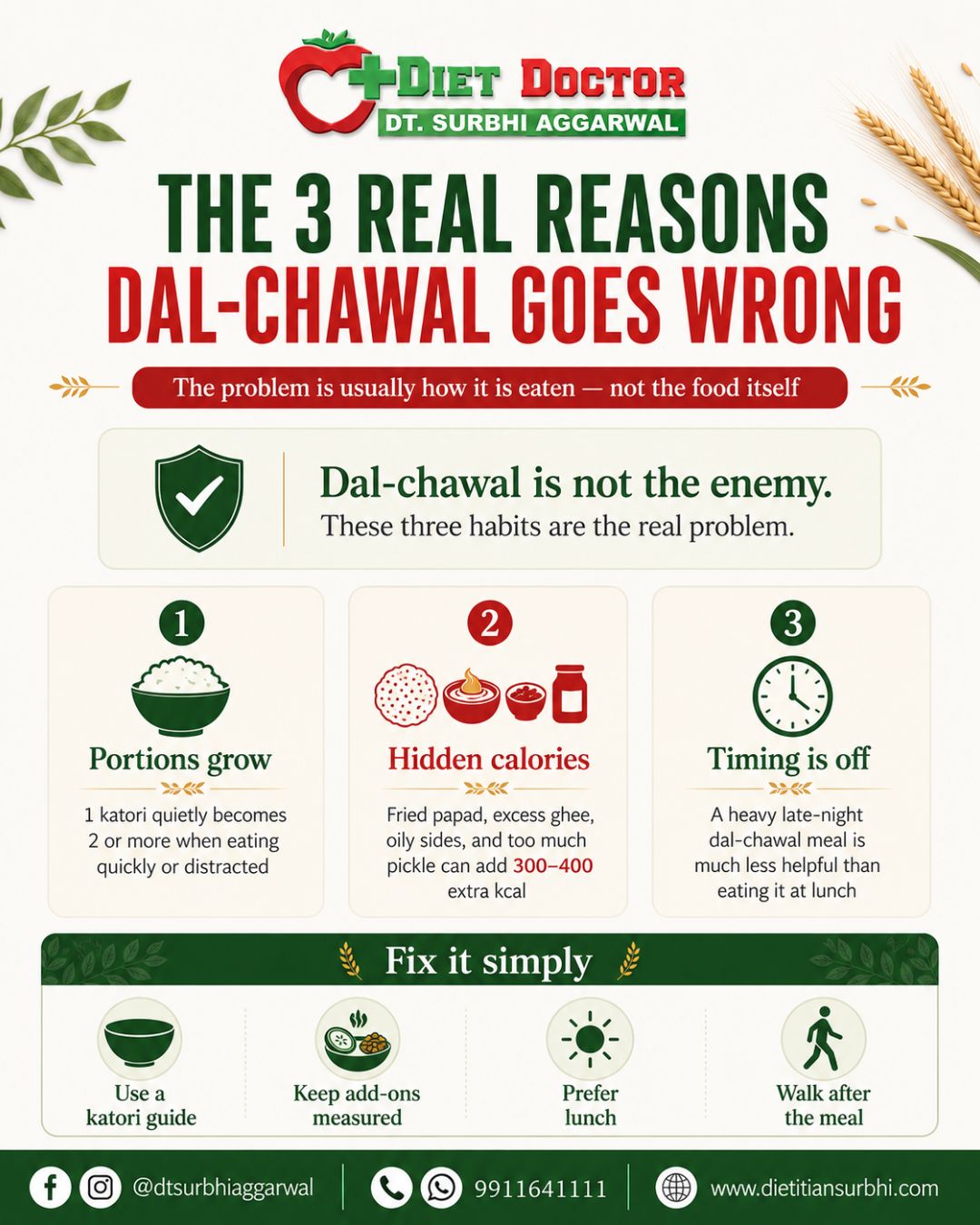
If dal-chawal itself isn’t the problem, what is? Based on what I see in my clinic, it consistently comes down to three things:
- The rice portion grows unchecked. A serving that started as one katori quietly becomes two and a half over the course of a meal, especially when eating with family or while distracted. The katori-based portion guide I use — one katori rice per meal for most adults at a moderate calorie deficit — rarely triggers the satiety alarm fast enough if people are eating quickly and without awareness.
- The accompaniments carry hidden calories. A tablespoon of ghee on hot dal is about 120 calories on its own. Fried papad adds another 80–100. Mango pickle in larger-than-thumb quantities can add sodium that drives water retention. None of these is unhealthy in measured amounts — but stacked together at every dal-chawal meal, they can add 300–400 extra calories to a bowl that otherwise would have been perfectly well-portioned.
- The timing is off. A large dal-chawal meal at 10 PM, eaten after a long day with no activity to follow, is a different metabolic event than the same meal at 1 PM with a 20-minute walk afterward. The meal hasn’t changed. The context has — and context matters more than most people realise.
Building the Weight-Loss Dal-Chawal Bowl
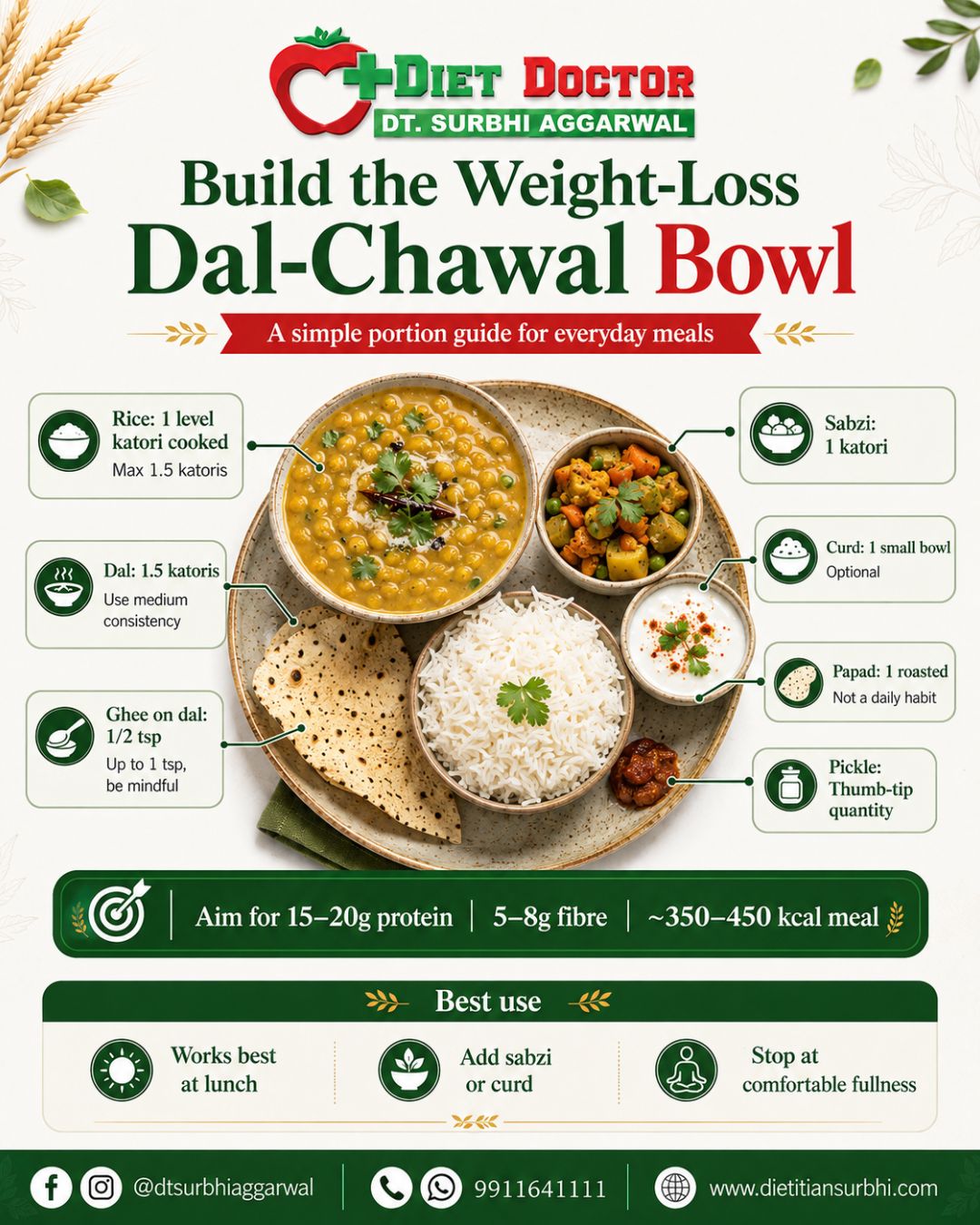
Here is the framework I give clients who want to make dal-chawal a regular part of a weight-loss plan:
| Element | Recommended | Limit |
| Rice | 1 level katori cooked | Max 1.5 katoris |
| Dal | 1.5 katoris, medium consistency | Avoid watered-down thin dal — you lose the protein |
| Sabzi | 1 katori cooked vegetable alongside | Anything seasonal, minimal oil |
| Curd | 1 small bowl | Optional but excellent for protein + probiotics |
| Ghee on dal | ½ tsp | 1 tsp is fine; more than that, be mindful |
| Papad | 1 roasted (not fried) | Avoid as a daily habit |
| Pickle | Thumb-tip quantity | More is mostly sodium, not nutrition |
The goal is a bowl that delivers 15–20g of protein, 5–8g of fibre, and keeps total calories for the meal in the 350–450 range for most moderately active adults. That’s a complete, satisfying lunch that will hold you until 5–6 PM without cravings.
A Sample Dal-Chawal Weight-Loss Day
This is a simplified example of how dal-chawal integrates into a full day of eating — the kind of structure I’d build as a starting point before personalising:
Breakfast (8–9 AM): 2 moong dal chilla + 1 small bowl curd or 1 boiled egg + 1 cup chai with minimal sugar
Lunch (12:30–1:30 PM): 1 katori rice + 1.5 katoris masoor or toor dal + 1 katori sabzi + 1 small bowl curd. Walk 10–15 minutes after if possible.
Evening (5–6 PM): 1 cup chai + a handful of roasted chana or 1 small fruit
Dinner (7:30–8:30 PM): 1–2 rotis + 1 katori sabzi + 1 katori dal or 1 katori paneer or egg. Light, earlier than the average family dinner if possible.
Notice that dal-chawal isn’t being eaten twice a day. It’s the lunch anchor. Dinner is roti-based. This spread of carbohydrate through the day — rather than concentrating it all at one meal — is one of the most effective, sustainable shifts I make in almost every personalised meal plan I build.
What I’ve Seen in My Clinic
One of the clients I think about most when people apologise for eating dal-chawal is a 38-year-old schoolteacher from Rohini. She’d been on a no-rice plan for four months before coming to me — eating salads, oats, and multigrain bread, foods that felt virtuous but made her miserable and left her so hungry by evening that she was bingeing on biscuits and namkeen before dinner.
We didn’t add anything exotic or remove anything dramatically. We brought back one katori of rice at lunch, added a proper dal with it, and shifted her evening snack to roasted chana. Within six weeks, her evening bingeing had stopped almost entirely. In three months, she had lost 4.8 kilos. She was eating a meal she genuinely enjoyed every afternoon, in her school’s staff room, from a dabba she packed at home.
Her comment at the three-month check-in stuck with me: “I’m not on a diet anymore. I’m just eating my food properly.”
That, in essence, is the Ghar Ka Khana philosophy.
Frequently Asked Questions
Is dal-chawal good for weight loss?
Yes, when portion sizes and accompaniments are managed. Dal-chawal provides a useful combination of plant protein, fibre, and complex carbohydrate that supports satiety and stable blood sugar. The problem in most cases is quantity and what’s added to it, not the combination itself.
How much dal-chawal can I eat per day for weight loss?
A practical starting point for most moderately active adults is one katori cooked rice and 1.5 katoris dal at lunch, once per day. This is a guide, not a fixed rule — a personalised assessment will refine it based on your body weight, activity level, and any medical conditions.
Which dal is best for weight loss?
All dals are nutritious. Moong dal (both whole and split) is particularly easy to digest and has a relatively lower calorie density. Masoor, chana, and toor are all excellent choices. The difference between them for weight loss is smaller than most people assume — what matters more is concentration, portion, and how the dal is prepared.
Does dal-chawal increase belly fat?
Not in and of itself. Belly fat accumulates from sustained overall calorie surplus, not from one specific food. Dal-chawal eaten in measured portions as part of a calorie-appropriate day does not cause belly fat accumulation.
Is it okay to eat dal-chawal at night for weight loss?
A lighter version — slightly smaller portions, with more dal and less rice relative to lunch — is fine as an occasional dinner, especially if eaten before 8 PM. As a daily heavy dinner eaten late, however, the lack of activity afterward makes it less optimal than eating it at lunch. If your schedule forces dinner to be your main meal, reduce the rice portion and keep the dal and sabzi generous.
Can people with diabetes eat dal-chawal?
In most cases, yes, with attention to the rice portion, the pairing (always eat with protein and fibre, never rice alone), and the timing of the meal. Diabetes management nutrition is highly individual — if you are managing diabetes and blood sugar levels, a tailored plan from a qualified dietitian will give you far more precise and safe guidance than a general article can. You can read more about how I approach this in our diabetes diet management programme.
I’ve been told to avoid rice entirely. Should I?
In most non-diabetic, non-insulin-resistant adults, total elimination of rice is neither necessary nor advisable for long-term weight loss. It is difficult to sustain, removes important nutrients, and often leads to the rebound eating pattern described earlier in this article. A small number of people with specific metabolic conditions do benefit from significant carbohydrate reduction — but that’s a medical conversation, not a blanket rule.
Ready to Stop Feeling Guilty About the Food You Love?
Dal-chawal isn’t the problem. The missing piece is usually a plan built around your real life, your actual food, and your body’s specific needs.
Book a consultation with Dietitian Surbhi and let’s build a weight-loss plan you can sustain for the long term — starting with the food already in your kitchen.
📞 Call / WhatsApp: +91-9911641111