
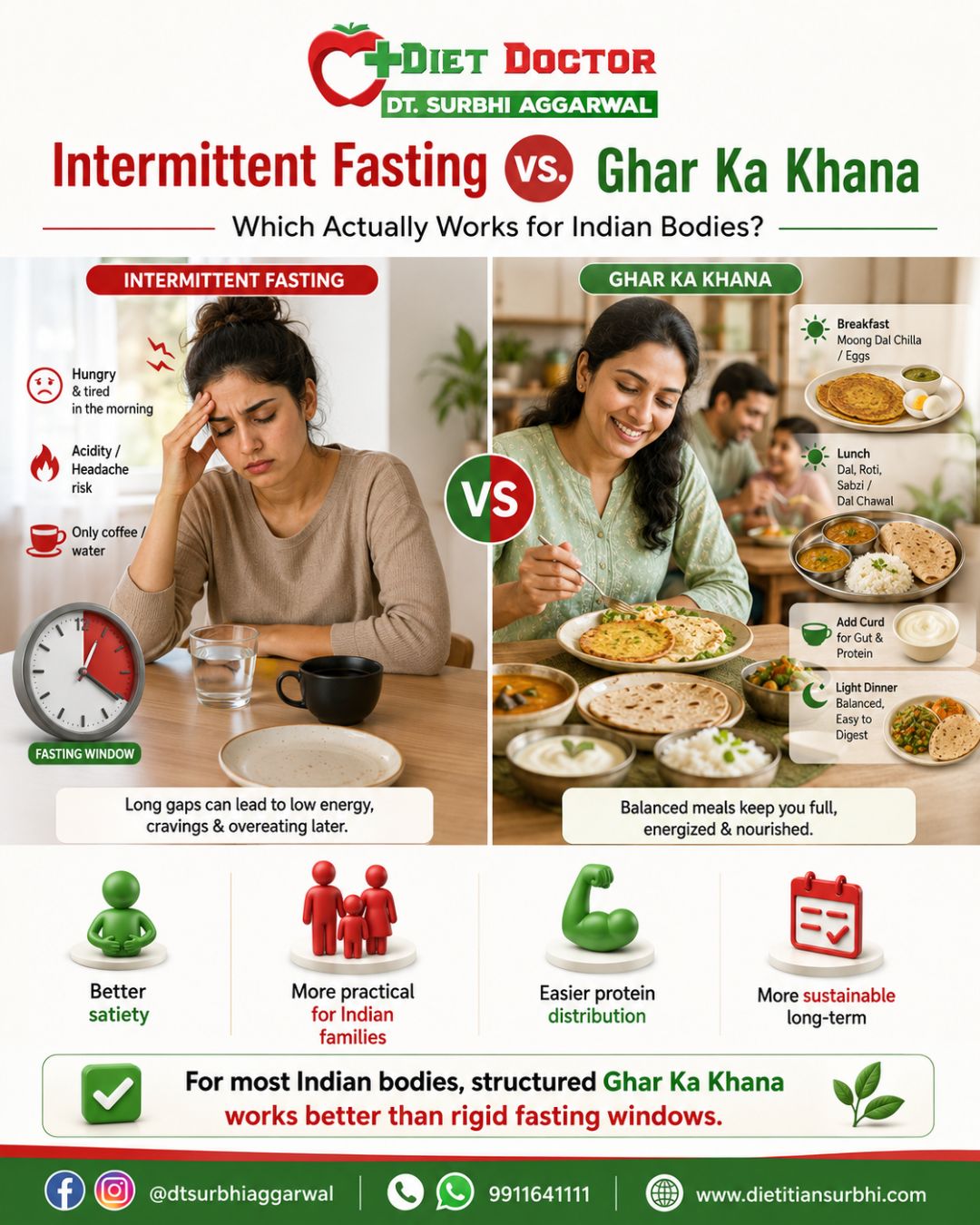
He had done everything right. Sixteen hours fasting, eight hours eating, no exceptions. He’d lost four kilos in the first six weeks. Then Diwali came, the family dinner schedule shifted, his work travel made the eating window impossible to maintain, and by January he had regained six. He came to my clinic not just heavier than when he’d started, but frustrated in a specific way — the kind of frustration that comes from doing something difficult and having it fail anyway.
I have seen some version of this story easily a hundred times. And as a clinician who has spent twelve years working with Indian clients across different body types, occupations, and family structures, I want to give you an honest answer to this question — not the one optimised for clicks.
What Intermittent Fasting Actually Is
Intermittent fasting (IF) is an umbrella term for eating patterns that cycle between periods of fasting and eating. The most popular version in India right now is 16:8 — fasting for 16 hours and eating within an 8-hour window (say, noon to 8 PM). Another variant is 5:2, where you eat normally five days a week and restrict to roughly 500 calories on two non-consecutive days.
The premise is that extending the fasting period forces the body to use stored fat for energy, lowers insulin levels, and may trigger cellular repair processes. This is a real biological mechanism. The question is whether it produces better results than structured, portion-controlled eating — and whether the lifestyle demands it places are realistic for most Indian households.
What the Research Actually Says
The honest answer is that the evidence for IF is more nuanced than its popularity suggests.
A 2020 study published in JAMA Internal Medicine examined 116 adults who followed a 16:8 time-restricted eating approach for 12 weeks. The researchers found that the IF group lost weight — but when compared against an unrestricted eating control group over the same period, the difference was not statistically significant. The conclusion that drew attention: time-restricted eating, absent an explicit effort to reduce calorie intake, may not produce meaningfully greater weight loss than simply eating regularly.
A 2022 review in the New England Journal of Medicine was more measured in its conclusions, acknowledging that IF can be an effective strategy for some people — particularly as a tool to reduce overall calorie intake — but noting that the long-term sustainability data remains limited and that most trials have been conducted in Western, non-South Asian populations.
That last point matters more than most people realise.
Why Indian Bodies and Lifestyles Complicate IF
The South Asian metabolic profile is different from Western populations
Research led by endocrinologist Prof. C.S. Yajnik at KEM Hospital, Pune, has documented for decades that South Asians — including Indians — tend to carry more visceral (abdominal) fat relative to overall body weight than people of European descent, even at similar or lower BMIs. This means Indians often develop insulin resistance and metabolic complications at body weights that would be considered normal by Western standards. The WHO has published separate BMI cut-off thresholds for Asian populations precisely because of this difference.
Why does this matter for IF? Because South Asian metabolic risk is driven more by fat distribution and insulin dynamics than by total body weight alone. Simply compressing an eating window without addressing what is eaten, how it’s portioned, and when carbohydrates are consumed doesn’t necessarily address the underlying insulin sensitivity issue. In my clinical experience, portion control, protein distribution through the day, and meal timing within a structured three-meal framework tend to produce more reliable metabolic improvements for Indian clients than the window itself.
The morning is your most metabolically efficient time — and IF skips it
Human metabolism follows circadian rhythms. Insulin sensitivity — the body’s ability to process carbohydrates efficiently — is naturally highest in the morning and declines through the day. Research in chronobiology has consistently shown that the same meal eaten at breakfast produces a smaller blood sugar spike than the same meal eaten at dinner. Eating a protein-rich, balanced breakfast takes advantage of this window. Standard 16:8 IF, which typically involves skipping breakfast and eating from noon onwards, misses it entirely.
For Indian clients specifically, most of whom are vegetarian or low in animal protein, breakfast is also often the most practical opportunity to get adequate protein before the family’s lunch and dinner schedules take over. Skipping it consistently tends to compress protein intake into two meals, which makes hitting even modest daily protein targets harder.
The acidity problem is real and underreported in IF discussions
India has one of the highest rates of gastroesophageal reflux disease and functional acidity in the world, and the morning chai-on-an-empty-stomach habit makes it worse. Most IF protocols that skip breakfast require someone to have had their last meal by 8 PM the previous night and not eat again until noon — a 16-hour stretch during which gastric acid continues to be produced, with nothing to neutralise it. For people who already experience acidity, this extended fasting window predictably makes symptoms worse, not better. In my clinic, when clients report that IF gave them severe acidity, headaches by mid-morning, or low blood sugar episodes, it is almost never a willpower problem. It is a physiology problem.
Indian family dinner culture and social eating conflict directly with IF windows
Most Indian families eat dinner between 8 and 10 PM. A 16:8 window that requires stopping eating by 8 PM means either eating dinner alone before the family, or missing the family meal — the social and emotional core of Indian households. A few clients sustain this for weeks. Almost none sustain it across festivals, travel, weddings, or winter months when daylight hours shift. The compliance problem with IF for Indian clients is not motivation. It is structural mismatch.
What Ghar Ka Khana Does Differently
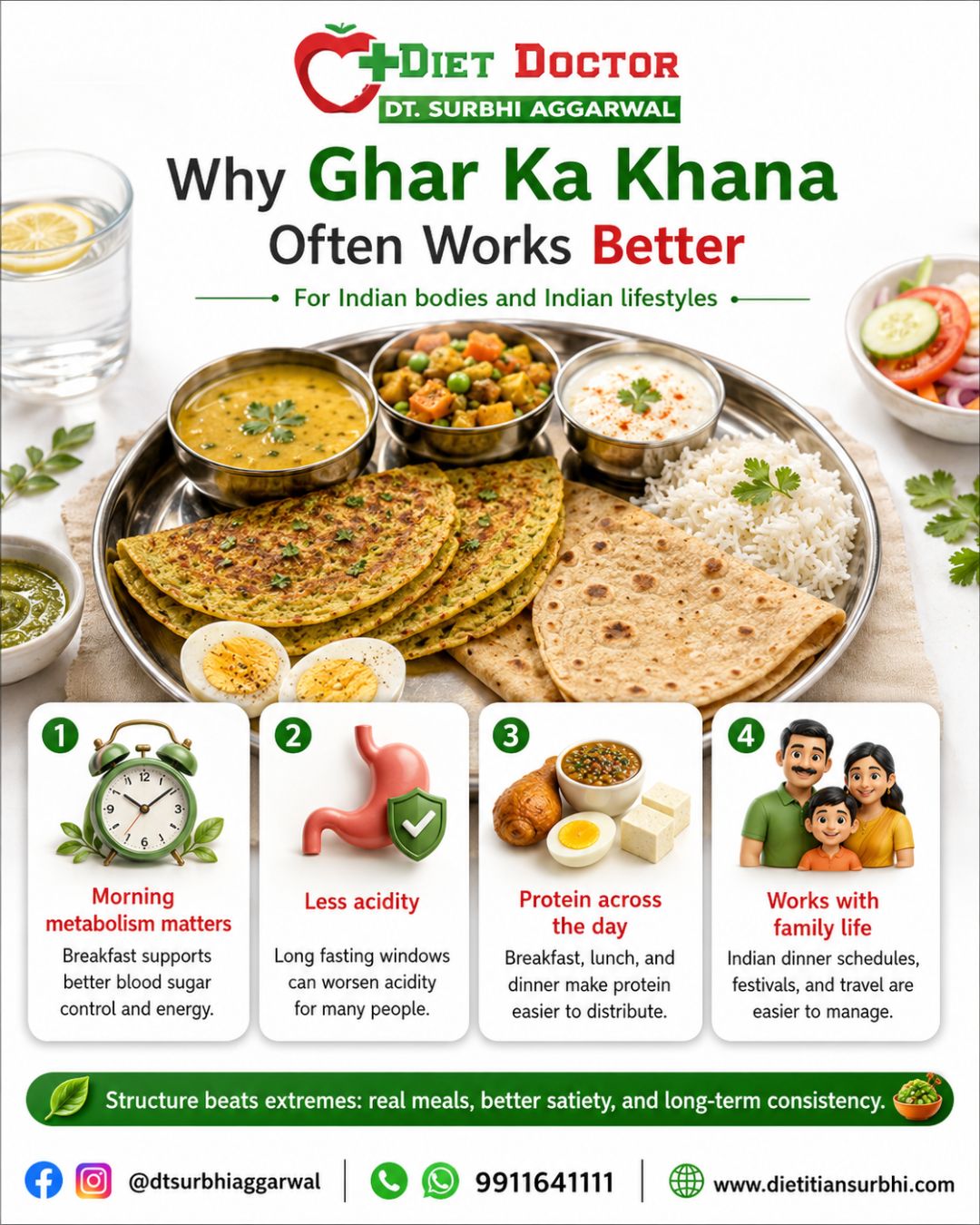
The approach I use is built around three structured meals that work with Indian food culture, not against it. No supplements, no meal replacements, no eating alone at 7 PM while the family waits.
The framework is straightforward: a protein-forward breakfast that uses what is already in the Indian kitchen (moong dal chilla, dalia, eggs, poha with added protein), a proper lunch — dal, roti or a measured portion of rice, sabzi, curd — at midday when the body handles carbohydrates most efficiently, and a lighter dinner eaten before 9 PM where possible. Between meals, the goal is genuine satiety from food that is filling, not constant small snacks that blur the meal structure.
What this creates is an eating pattern that is, in practice, naturally time-compressed without formally calling itself IF. Most clients on this structure end up eating across a 10–12 hour window simply because their first meal is at 8 AM and their last is at 7:30–8 PM. But they are not fasting. They are eating three real meals, avoiding the acidity problem, maintaining the family dinner, and getting adequate protein across the day.
A Direct Comparison: IF Day vs. Ghar Ka Khana Day
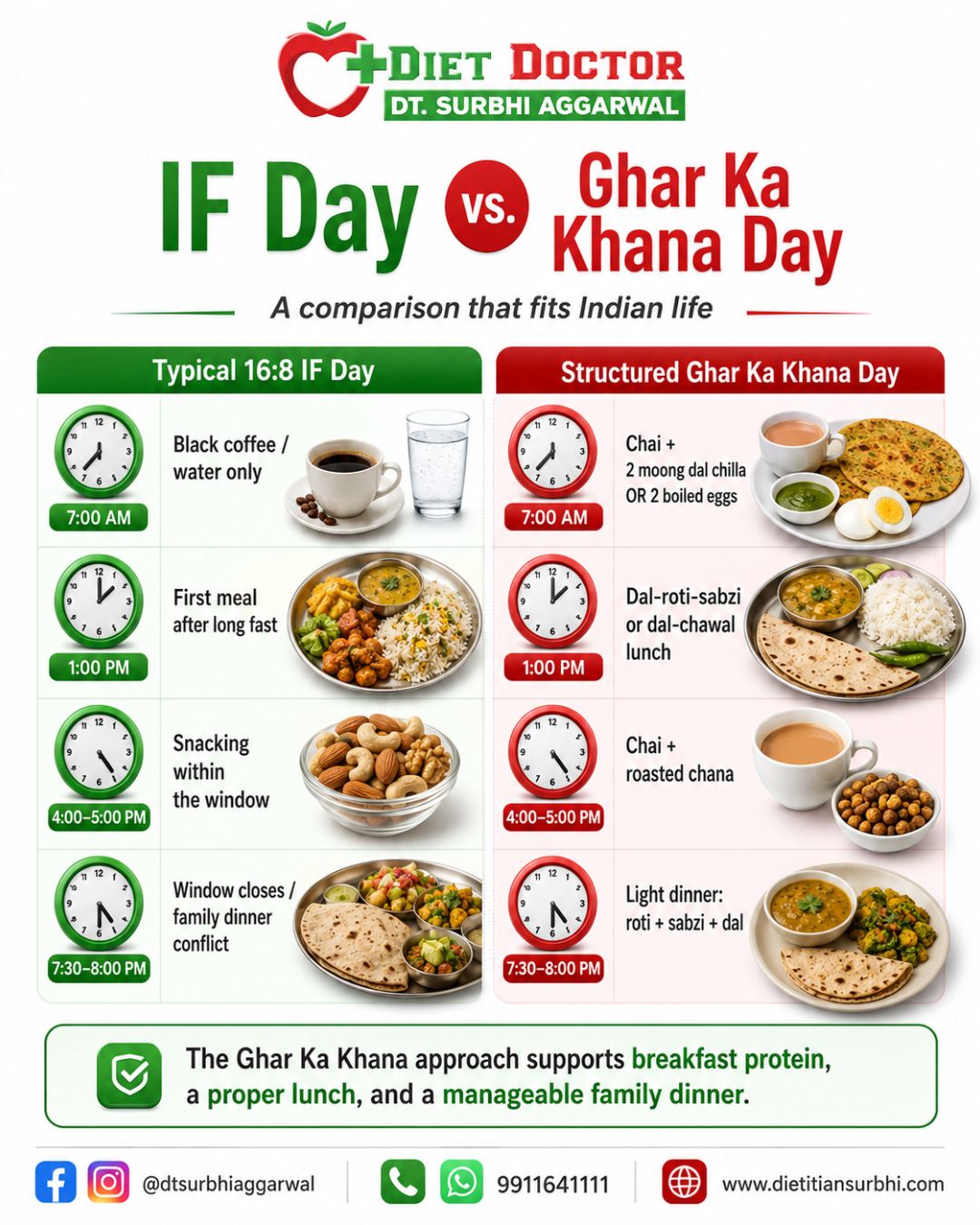
| Time | Typical 16:8 IF Day | Ghar Ka Khana Day |
| 7:00 AM | Black coffee or water only | Chai + 2 moong dal chilla OR 2 boiled eggs + toast |
| 9:00 AM | Still fasting | Mid-morning fruit if needed, or nothing |
| 12:00 PM | First meal: often a large meal after 16-hr fast | — |
| 1:00 PM | — | Dal-chawal or roti-sabzi (main lunch) |
| 4:00–5:00 PM | Snacking within window | Chai + small handful roasted chana |
| 7:30–8:00 PM | Last meal before window closes | Light dinner: 1–2 rotis + sabzi + dal |
| 9:30–10:00 PM | Family dinner missed or eaten outside window | Kitchen closed |
The IF column skips a morning meal and risks a large compensatory lunch, misses breakfast protein, and conflicts with a family dinner at 9 PM. The Ghar Ka Khana column hits protein at breakfast, front-loads carbohydrates at lunch, and keeps dinner light and on time.
When IF Might Actually Work for an Indian Client
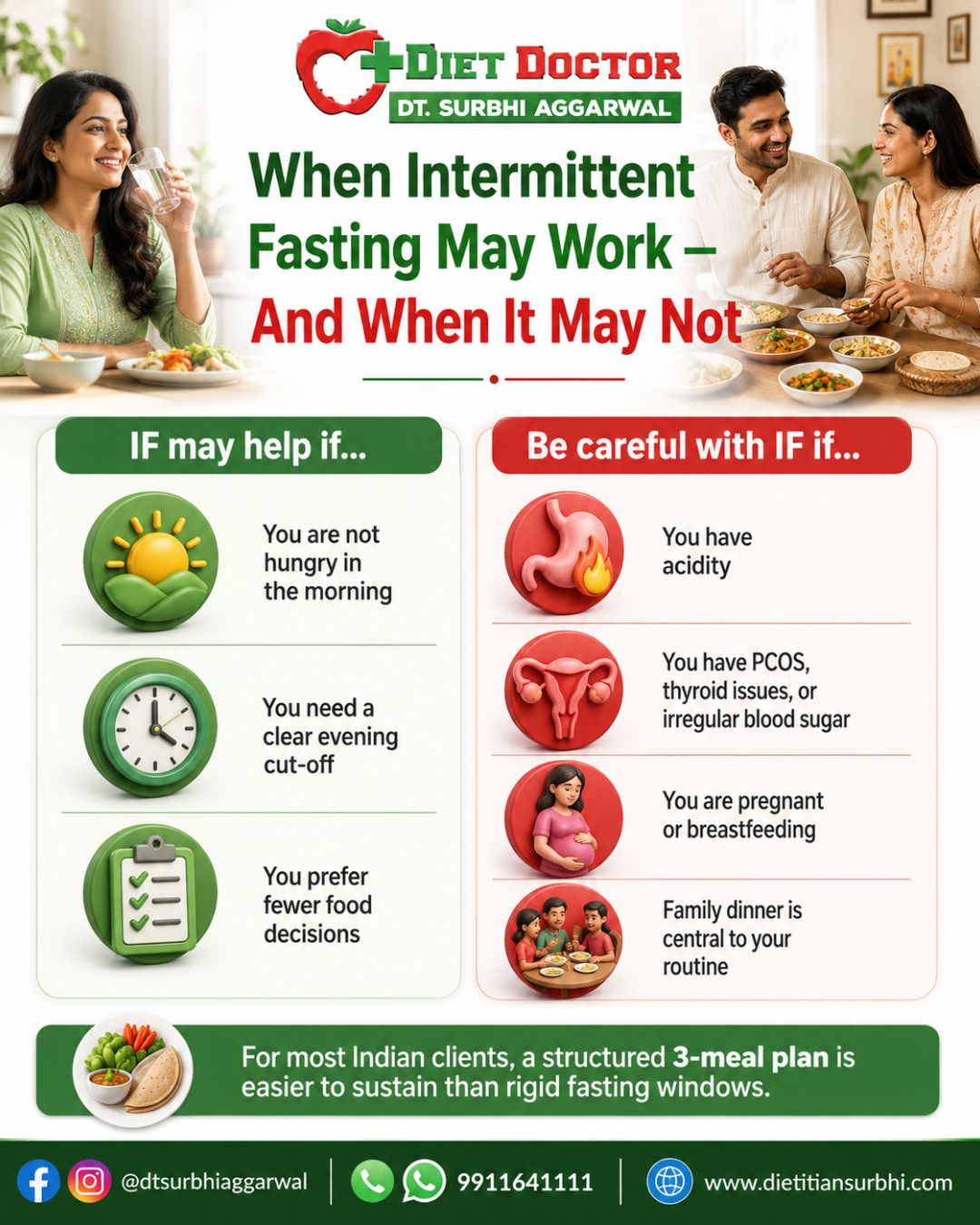
I want to be fair to IF, because it genuinely suits some people.
If you do not feel hungry in the morning and consistently eat too much in the evenings, a compressed window can be a practical tool to reduce that evening overeating — but the window should probably run from 10 AM to 6 PM, not noon to 8 PM, to account for Indian meal timing. If you are managing late-night snacking and need a clear “eating is closed” rule, an 8 PM cutoff can be genuinely useful. And for some people, the simplicity of fewer decisions each day reduces decision fatigue around food.
But if you have acidity, thyroid issues, irregular blood sugar, PCOS, are pregnant or breastfeeding, or are simply in a household where dinner is the family anchor — IF is likely to create more problems than it solves. Those are not edge cases in India. They describe the majority of people trying IF.
What I’ve Seen in My Clinic
The client I described at the opening of this article is not unusual. What is more instructive is what happened next. We stopped IF entirely. We rebuilt his meals around the structure above — proper breakfast, dal-chawal at lunch, light dinner by 8 PM, and a genuine focus on protein at each meal. His eating window ended up being about 12 hours, naturally, without any fasting protocol.
In four months, he lost the six kilos he had regained, plus one more. More importantly, he kept losing slowly through Holi, through a Pune business trip, and through his daughter’s school function where the food was entirely out of his control. He adjusted, came back to the structure the next day, and continued.
That sustained progress through real life, without restriction, without skipping the family dinner — that is what a plan built for an Indian body and an Indian life should produce.
Frequently Asked Questions
Can I do intermittent fasting on an Indian diet?
Technically yes — IF is a timing framework, not a food framework, so you can eat dal, roti, and sabzi within a compressed window. The question is whether the window works with your meal culture. For most Indian households where dinner is between 8 and 10 PM, a 16:8 window is structurally difficult to maintain long-term.
Does intermittent fasting work for weight loss in Indians?
Some Indian clients do lose weight on IF, particularly in the early weeks. The challenge is sustainability — compliance drops significantly when social eating, travel, festivals, or family dynamics conflict with the eating window, which happens regularly in Indian life. Studies comparing IF to continuous calorie restriction generally show similar weight loss outcomes, suggesting the structure of meals matters more than the fasting window itself.
I have acidity. Can I still try IF?
I would recommend caution. Extended fasting without food to neutralise gastric acid commonly worsens acidity symptoms, especially in people who already have this tendency. If you want to try a compressed eating window, starting earlier (e.g., 8 AM to 6 PM) rather than a delayed-eating model is less likely to aggravate acidity.
Is it better to skip breakfast or dinner for an Indian weight-loss plan?
Based on what we know about circadian insulin sensitivity, skipping dinner (or making it very light and early) is generally more metabolically sound than skipping breakfast. Breakfast skipping misses the window when the body handles carbohydrates most efficiently. A large dinner late at night is the eating pattern most consistently associated with weight gain and poor blood sugar control in clinical literature.
How is the Ghar Ka Khana approach different from just “eating less”?
The difference is in structure, not deprivation. Eating less without a framework tends to mean skipping meals erratically, snacking because hunger accumulates, and ending up with a deficit on some days and a surplus on others. A structured three-meal approach distributes food across the day to manage hunger, stabilise blood sugar, and make the calorie reduction sustainable without feeling like restriction.
I lost weight on IF initially but regained it. Why?
The most common reason is that the initial weight loss reflects water loss from glycogen depletion (stored carbohydrate in the liver holds water, and reducing carbohydrate intake depletes it), followed by genuine fat loss during the first weeks of compliance, followed by compliance breaking down as social and practical pressures accumulate. The weight returns when eating patterns return to baseline. Sustained weight loss requires a plan that holds up across real Indian life — not just across a controlled few weeks.
Which should I choose — IF or a structured Indian meal plan?
This depends on your acidity history, your family meal culture, your schedule, and whether you have any hormonal or metabolic conditions. For most of the clients I see in Delhi NCR, a structured three-meal Indian approach produces better long-term results with fewer side effects. But the honest answer is that no single framework works for everyone — which is exactly why a personalised consultation is worth doing before committing to any protocol.
Not Sure Which Approach Is Right for Your Body?
The answer depends on your specific blood reports, lifestyle, and health history — not on which diet trend is most popular right now.
Book a consultation with Dietitian Surbhi and let’s find the approach that actually fits your life — not just the first six weeks of it.
📞 Call / WhatsApp: +91-9911641111