

She came to me three weeks before her wedding having done the GM diet twice back-to-back. She had lost 4 kilos. She had also, she told me in a slightly panicked voice, started losing hair — more than usual, noticeably, in the shower — and her skin looked dull and dry under the mehendi parlour lights. Her energy was terrible. She couldn’t sleep properly from the stress. And she had a five-day wedding starting in twenty-two days.
I see some version of this story every wedding season across my clinics in Punjabi Bagh and Model Town, and more recently from online clients preparing for big events. The desire to look a certain way for the biggest day of your life is completely understandable. The problem is that the approach most brides and grooms take — severe restriction, crash diets, skipping meals — produces precisely the opposite of what they want. Dull skin. Brittle hair. Puffy face. Zero energy for five nights of dancing.
Having worked with hundreds of brides, grooms, and their families across Delhi NCR over twelve years, here is what actually works.
Why Crash Dieting Before a Wedding Backfires
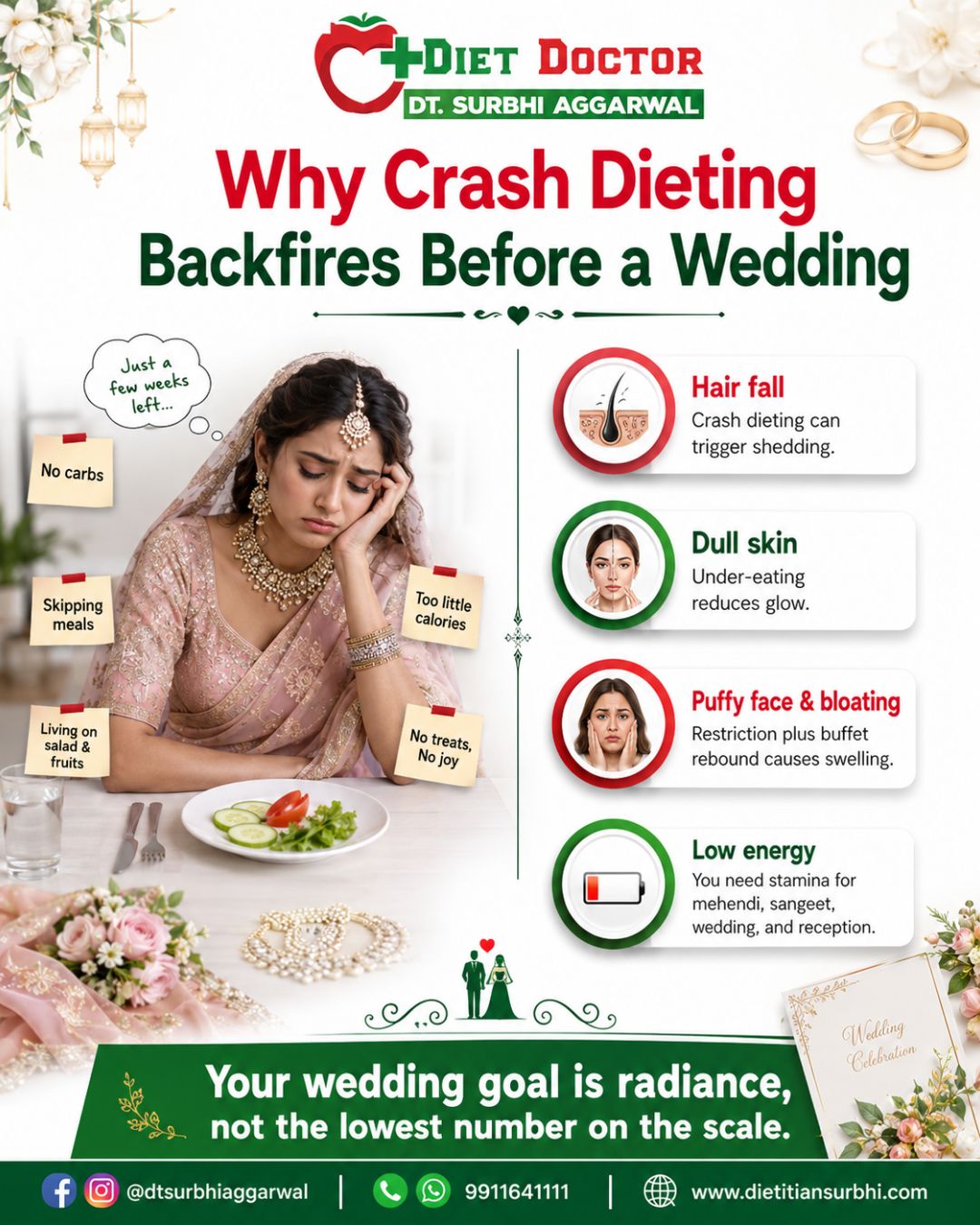
The goal on your wedding day is not to be your lightest. It is to be your most radiant — glowing skin, thick hair, clear eyes, enough energy to smile genuinely at 11 PM when the baraat is still dancing and your feet have been hurting for four hours. Severe calorie restriction actively works against every one of those things.
It triggers hair fall at exactly the wrong time
This is the one that surprises brides most. Hair follicles are protein-dependent — they need a consistent supply of amino acids, iron, zinc, and biotin to stay anchored. When calorie intake drops sharply and protein becomes inadequate, the body redirects available nutrients away from non-essential functions (hair growth) toward survival functions (heart, brain, organs). The result is a condition called telogen effluvium — a shedding phase where hair follicles prematurely enter a resting state and begin falling out. The clinical literature consistently documents telogen effluvium occurring 6–12 weeks after a major nutritional stress, which means a crash diet in October shows up as significant hair loss just in time for your December wedding. By the time you notice the shedding, the trigger has already been pulled.
It makes skin look dull, not dewy
The “pre-wedding glow” people talk about has a real biological basis — it comes from adequate hydration, collagen synthesis (which requires protein and vitamin C), and healthy skin cell turnover (which requires vitamin A and zinc). Severe calorie restriction depletes all of these simultaneously. Severely restricted clients almost universally present with dry, lacklustre skin within four to six weeks of starting, because the skin is one of the first places the body reduces resources when nutrients are scarce. No facial or bridal package can reverse what under-nutrition creates from the inside.
It causes bloating and puffiness, not slimness
Here is the cycle that ruins wedding photos: you restrict for three weeks, lose mostly water weight, arrive at your first function feeling “on track,” eat at the wedding buffet because you are genuinely ravenous and haven’t eaten properly in weeks, and wake up the next morning 1.5 kilos heavier, puffy-faced, and bloated — because your digestive system, unaccustomed to a normal meal volume, has reacted with inflammation and water retention. This is not a willpower failure. It is the predictable physiological response to restriction followed by normal eating.
It crashes your energy at the worst possible moment
A typical Indian wedding spans four to six days of functions — mehendi, sangeet, haldi, the wedding ceremony, reception, and often a bidaai or post-wedding lunch. Each of these days involves hours of standing, dancing, posing for photographs, receiving guests, managing family logistics, and managing emotions. This requires sustained energy. A body running on 700 calories of salad and fruit does not have that energy. The exhaustion shows in photographs in a way that foundation cannot cover.
What Actually Makes You Look Your Best in Wedding Photos
The clients who look visibly radiant on their wedding day — and I have seen hundreds of wedding photographs over the years — share a few consistent patterns. They have adequate protein in their diet in the months leading up. Their iron levels are in a healthy range. They are sleeping well. They are not severely restricting. And they have lost fat gradually, if weight loss was their goal, rather than crashing their calories two weeks before.
The nutrients most directly responsible for the “bridal glow” are straightforward: protein for skin firmness, muscle tone, and hair strength; iron and vitamin B12 for energy and clear eyes (dark circles under eyes are often a sign of low iron, which is extraordinarily common in Indian women); vitamin C for collagen synthesis; zinc and biotin for hair and skin cell health; and adequate hydration — at least 2.5 litres of water daily — for the plump, dewy skin texture that photographs beautifully. These are not exotic supplements. They are what a well-structured Ghar Ka Khana diet provides every day. Which is exactly why the personalised wedding nutrition plans I build for brides and grooms look nothing like a crash diet — they look like improved versions of what the person was already eating.
How Much Time Do You Have? Start Here
If you have 3+ months before the wedding:
You have enough time for genuine, sustainable fat loss of 4–8 kg alongside meaningful improvements in skin, hair, and energy. A structured plan starting now gives your body time to lose fat gradually without triggering metabolic adaptation, hair loss, or nutrient depletion. This is the ideal window. Start with a consultation and get blood tests done — iron, vitamin B12, vitamin D, and thyroid at minimum — so we know exactly what we are working with.
If you have 6–10 weeks: Moderate fat loss of 2–4 kg is realistic while still prioritising nutrient density and skin/hair health. The emphasis shifts slightly: rather than aggressive deficit, the focus is on cleaning up eating patterns, front-loading protein, and resolving any nutritional deficiencies that might be affecting how you look and feel.
If you have 2–4 weeks: Significant weight loss is no longer the goal. The goal is to look and feel your absolute best with what you have. This means optimising water intake, reducing sodium and bloating-causing foods, ensuring adequate protein, prioritising sleep, and not introducing any dramatic dietary changes that could disrupt digestion right before the wedding. Two weeks of genuinely good eating will make a visible difference in skin quality and energy. Two weeks of crash dieting will not produce meaningful fat loss and will reliably worsen both.
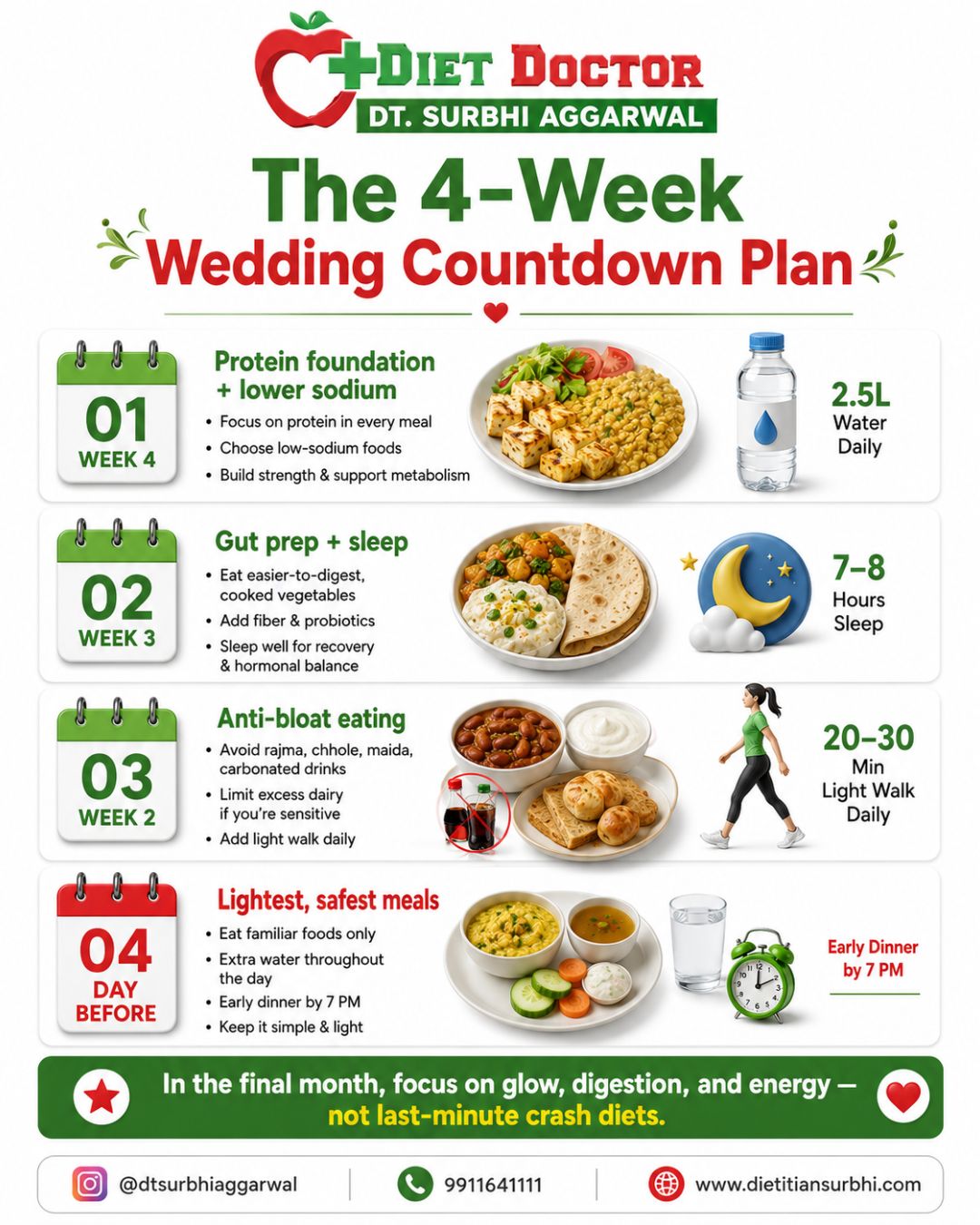
The 4-Week Wedding Countdown Plan
This is the framework I give clients in the final month before a wedding. It is not a weight-loss plan — that work should have been done earlier. This is a look-your-best, feel-your-best, don’t-crash-on-day-three plan.
| Week | Focus | Key Actions |
| Week 4 (28–21 days out) | Protein foundation + sodium reduction | Hit 1.2–1.5g protein per kg body weight daily; cut processed/packaged snacks; reduce pickle, papad, sauces that carry hidden sodium; drink 2.5L water |
| Week 3 (20–14 days out) | Gut prep + sleep priority | Shift to easier-to-digest cooked vegetables (reduce raw salads if digestive sensitivity); no new foods or exotic diets; 7–8 hours of sleep non-negotiable; reduce chai/coffee if heavy consumption |
| Week 2 (13–7 days out) | Anti-bloat foods only | Avoid rajma, chhole, whole legumes, maida, carbonated drinks, excess dairy if you are sensitive; eat familiar, cooked, moderate-sodium meals; extra water; light daily walk |
| Day before wedding | Lightest, safest eating | Very familiar meals, nothing heavy or new; slightly higher water intake; avoid street food or caterer food if you can; early dinner by 7 PM |
Foods that cause bloating — avoid from 3 days before any function
Rajma, chhole, and whole legumes (gas-producing for many people), maida-heavy items (white bread, pastries, fried snacks), carbonated drinks, raw cabbage and broccoli in large quantities, excess pickle and papad (sodium drives water retention and facial puffiness), heavy restaurant gravies loaded with cream or butter, and anything your stomach is not accustomed to. This is not about these foods being unhealthy — it is about timing. The week of your wedding is not the time for culinary experiments.
Navigating Multi-Day Wedding Functions Without Derailing
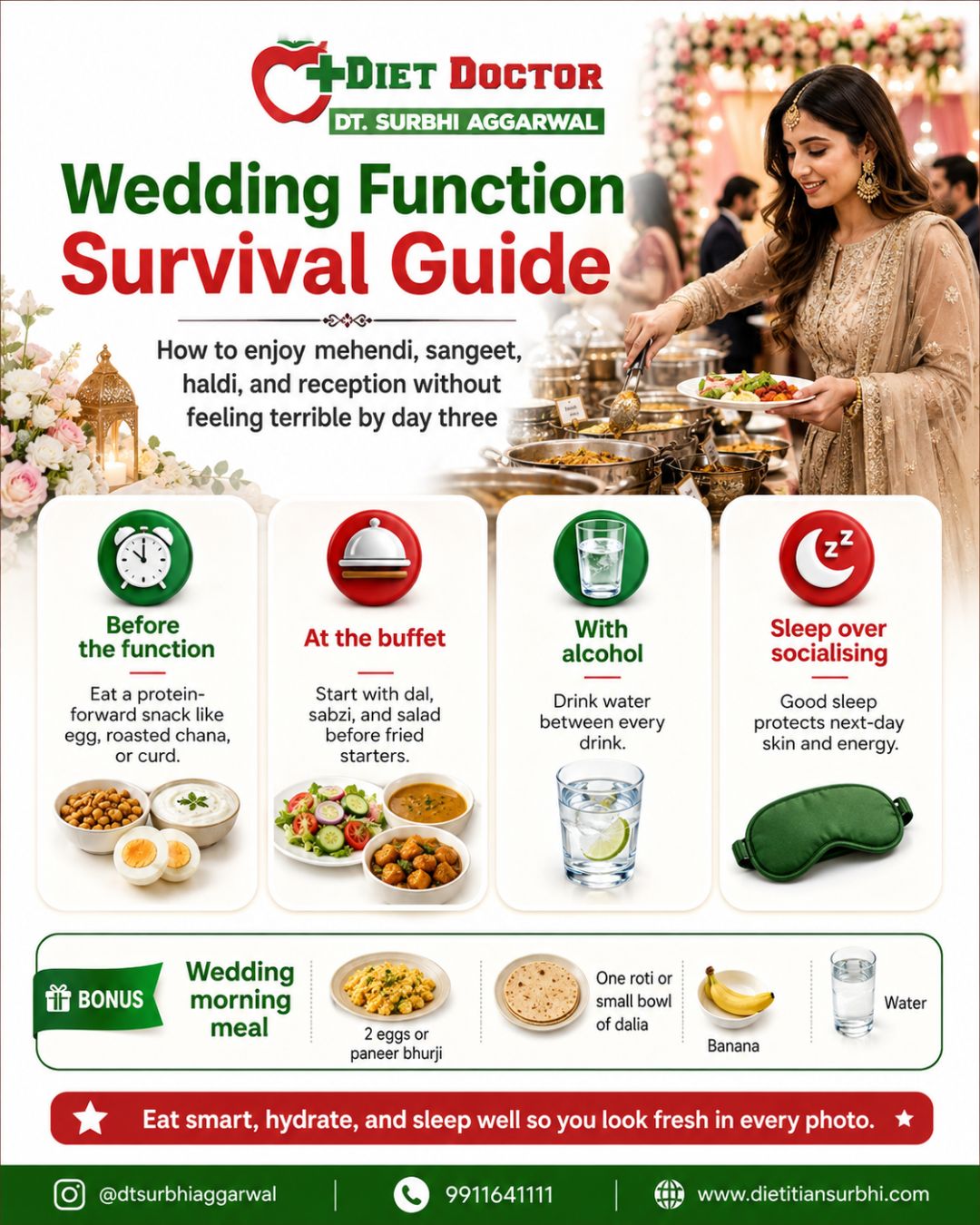
Indian weddings are food events. Five days of mehendi, sangeet, haldi, ceremony, and reception mean five days of heavy buffets, late-night meals, and continuous snacking. Here is how to move through them without feeling terrible by day three.
Before every function: Eat a small, protein-forward snack before you leave the house — a boiled egg, a handful of roasted chana, a small bowl of curd. Going to a function starving guarantees overeating and poor choices at the buffet.
At the buffet: Start with the dal, sabzi, and salad before touching the fried starters. Eat slowly — buffets are designed for speed, your digestion is not. Take one round, eat it fully, and decide if you genuinely want more before going back.
With alcohol: If you drink, have water between every alcoholic drink. Alcohol dehydrates, disrupts sleep, and heavily disrupts blood sugar the following morning — all three make you look and feel worse. This matters more in the week of your own wedding than at anyone else’s.
Sleep over socialising: If it is 12:30 AM and the sangeet is winding down, leaving to sleep is the highest-leverage beauty decision you can make for how you look tomorrow. No night cream substitutes for six hours of sleep.
What to Eat on the Morning of Your Wedding
This is the question I get most often, and the answer is simpler than people expect: eat something you know your body handles well, make it protein-forward, and do not skip it.
Nervousness suppresses appetite on wedding mornings. Many brides eat almost nothing before a four-hour ceremony and then wonder why they feel faint during the pheras. Blood sugar drops during long ceremonies. Dizziness, emotional flooding, and shakiness are far more likely on an empty stomach than a fed one.
A practical wedding morning meal: 2 eggs or a small bowl of paneer bhurji, one roti or a small bowl of dalia, a banana, and water. Familiar, easy to digest, protein and carbohydrate balanced, nothing that will cause gas or discomfort. Keep a small packet of roasted chana or a banana in your bridal bag for between rituals. Tell someone in your bridal party to remind you to eat and drink water — because you will forget.
What I’ve Seen in My Clinic
The client I described at the beginning of this article was, in some respects, a difficult case — the hair loss had already been triggered and would take 3–4 months to reverse, which meant her wedding day would not be the full recovery we both wanted. What we could do in three weeks was stabilise her nutrition, stop the crash, bring protein back up significantly, reduce her pre-wedding bloating with specific food changes in the final 10 days, and support her energy enough that she felt genuinely well during the wedding.
She wrote to me six months later. Her hair had fully recovered. She had continued eating properly after the wedding rather than returning to restriction, and had actually continued losing weight slowly — about 3 kilos in four months — without any deliberate dieting. The wedding had, somewhat unexpectedly, become the catalyst for finally stopping the cycle.
That outcome — gradual, sustainable improvement that continues after the event rather than collapsing the day after — is what every pre-wedding nutrition plan should aim for.
Frequently Asked Questions
How early should I start a pre-wedding diet plan?
Ideally 4–6 months before the wedding if fat loss is a goal, and 6–8 weeks minimum if the focus is on skin, hair, and energy improvement. The 2-week crash before the wedding is the least effective and most counterproductive window to start — at that point, the goal shifts to optimising appearance with what you have, not losing weight.
How much weight can I lose in 2 months before my wedding?
Realistically and healthily, 4–6 kg of actual fat loss is achievable in 8 weeks with a structured, moderate-deficit plan and adequate protein. More than that would require restriction aggressive enough to risk hair loss, energy crashes, and metabolic slowdown — none of which serve you on the wedding day. A 2-month timeframe that prioritises both weight loss and nutrient density produces noticeably better wedding-day results than a 2-month crash.
What should I avoid eating in the week before my wedding?
High-sodium foods (pickle, papad, fried snacks), gas-producing legumes (rajma, chhole, whole moong), maida-heavy items, carbonated drinks, raw vegetables in large quantities, heavy restaurant curries, and anything new to your diet. Stick to familiar, cooked, moderate meals that your digestion knows how to handle.
Will losing weight make my face look thinner in wedding photos?
Moderate fat loss — the kind that happens over several months at a sustainable pace — can change face shape meaningfully. Rapid crash-diet weight loss tends to produce a gaunt rather than lean appearance, because muscle is lost alongside fat, and skin loses the firmness that comes from adequate protein and collagen. Photographers consistently report that well-nourished subjects photograph better than severely restricted ones, even when the scale numbers are similar.
I have a wedding in 10 days. What can I do now?
Cut sodium and bloating-causing foods immediately. Increase water to at least 3 litres daily. Prioritise protein at every meal — eggs, paneer, dal, curd. Avoid any new diet or dramatic food change. Sleep as much as possible. These steps alone will make a visible difference in skin quality, eye brightness, and facial puffiness within 10 days. Accept that significant weight loss is not realistic in this window, and focus your energy on looking genuinely well rather than just lighter.
Is it true that skipping meals makes your face look thinner?
Temporarily, yes — an empty stomach causes less digestive bloating. But the puffiness from sodium, inflammation, and poor sleep has a far larger impact on face appearance than whether you ate lunch. Additionally, skipping meals on wedding day is a reliable route to low blood sugar, shakiness, and the kind of exhaustion that shows in photographs. Eat a proper breakfast on your wedding morning, every time.
Can I take supplements for skin glow before my wedding?
Supplements are not a substitute for a nutrition foundation. That said, if blood tests reveal a vitamin D, iron, or B12 deficiency — which is common in Indian women and extremely common in women who have been crash dieting — addressing those deficiencies through supplementation under medical guidance can make a visible difference. Do not buy a “bridal glow” supplement package without knowing your blood values first. Most of those packages contain low doses of multiple nutrients and produce minimal effect in a timeframe of weeks.
Ready to Look Your Absolute Best on Your Wedding Day?
Whether your wedding is in two months or six, a personalised plan built around your body, blood reports, and realistic timeline will always produce better results than a generic crash diet — for your weight, your skin, your hair, and your energy across the full wedding week.
Book a pre-wedding consultation with Dietitian Surbhi — available in-clinic at Punjabi Bagh and Model Town, and online across India.
📞 Call / WhatsApp: +91-9911641111