

She had lost eleven kilos in two months. When she sat across from me in my Punjabi Bagh clinic, she wasn’t celebrating. She had gained fourteen back in the three months that followed, and she had come in because she was convinced something was medically wrong with her — that her thyroid was broken, or her hormones had gone haywire, or her body simply refused to lose weight.
Nothing was medically wrong with her. What had happened to her body was entirely predictable. And in twelve years of clinical practice with more than 5,000 clients, I have watched it happen in almost exactly the same sequence — the early success, the plateau, the rebound, the shame spiral — more times than I can count.
The crash diet didn’t fail because she lacked willpower. It failed because her body is smarter than the diet.
What Qualifies as a Crash Diet
Before we get into the biology, let’s be specific about what we’re talking about. A crash diet is any eating plan that drops calorie intake dramatically below what the body needs for normal function — typically below 800–1,000 calories per day — usually to produce fast, visible weight loss in a short window. The form varies: extreme calorie cutting, liquid-only cleanses, GM diets, aggressive low-carb or ketogenic protocols when pushed to very low calories, 7-day “detox” plans, or simply eating almost nothing during the day and having one meal at night.
The National Institute of Nutrition (ICMR-NIN), India’s primary nutrition research body, recommends a minimum daily intake of approximately 1,200 calories for sedentary women and 1,600 calories for sedentary men. Most crash diets operate well below these thresholds. That gap between what the body needs and what it is receiving sets in motion a cascade of physiological responses — and those responses are the reason every crash diet eventually runs out of road.
Why the First Three Months Follow the Same Arc
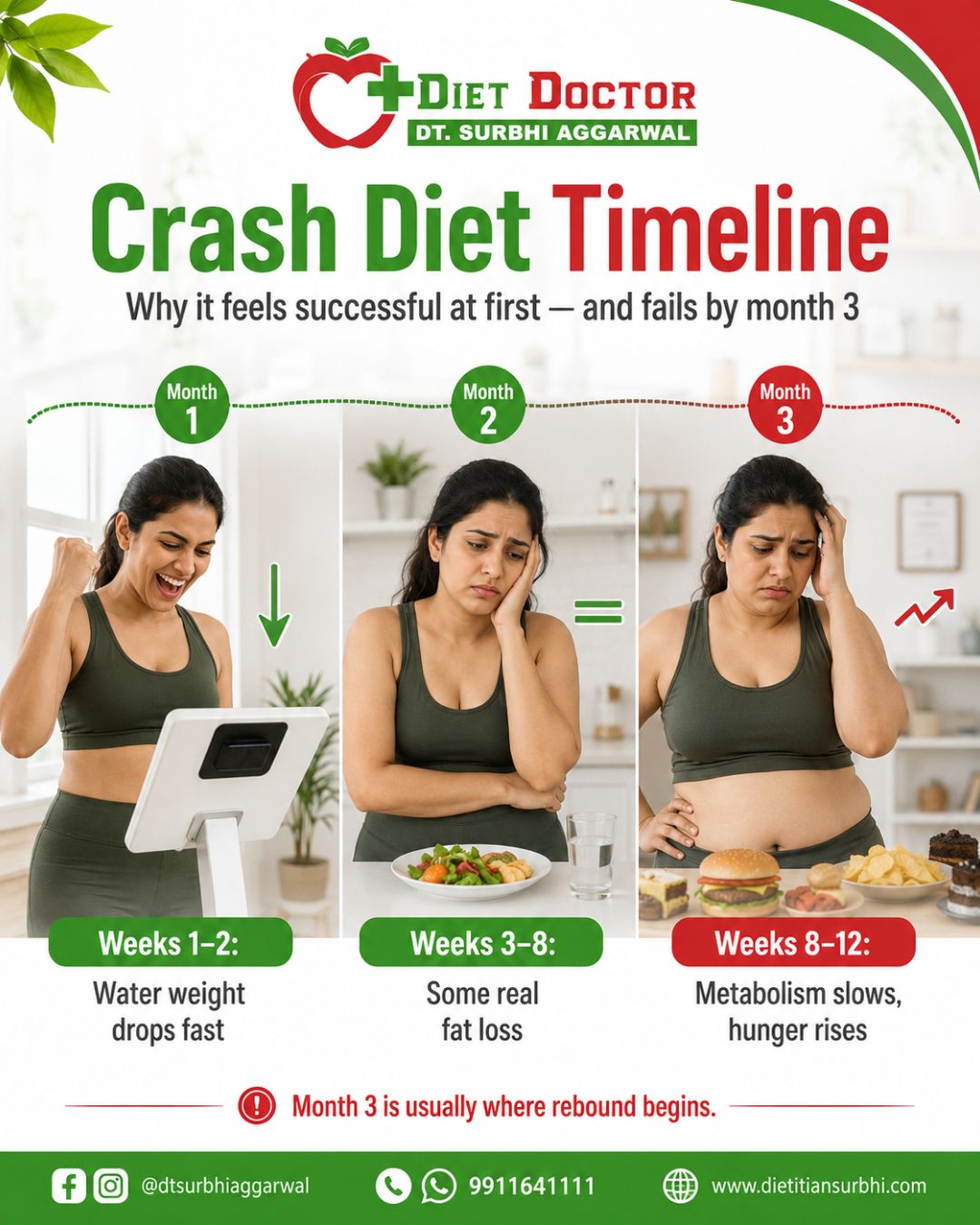
Understanding the timeline helps explain why month three, specifically, tends to be where things unravel.
Weeks 1–2: The dramatic opening.
The scale moves fast and the enthusiasm is real. Most of this early loss is not fat — it is water. The body stores carbohydrates as glycogen in the liver and muscles, and each gram of glycogen is stored with approximately 3 grams of water. When carbohydrate intake drops sharply, glycogen is depleted, and that stored water leaves the body quickly. Clients often lose 2–4 kilos in the first two weeks without losing much fat at all. The number on the scale feels like proof that the plan is working.
Weeks 3–8: The genuine progress window.
As glycogen stores empty, the body begins breaking down fat for energy. Actual fat loss begins — typically slower than that initial water loss, but real. This is when clients feel most confident. The plan feels manageable. Results are visible. Social reinforcement kicks in as people around them notice.
Weeks 8–12: The body begins to fight back.
This is where the biology becomes the problem.
At around the six-to-eight-week mark, a sustained severe calorie restriction triggers what researchers call metabolic adaptation — the body reducing the number of calories it burns at rest to match the reduced intake. A landmark follow-up study of The Biggest Loser contestants published in the journal Obesity in 2016 found that six years after the competition, contestants’ resting metabolic rates were still significantly lower than predicted for their body size — in some cases by 400–500 calories per day. Their bodies had learned to run on less, and that adaptation had not reversed. The study’s lead researcher, Dr. Kevin Hall of the National Institutes of Health, described this as persistent metabolic adaptation — the body defending its weight by becoming permanently more efficient.
This is not unique to extreme cases. It happens to anyone who sustains a severe calorie deficit long enough.
Month 3 and beyond: Compliance breaks.
By this point, hunger is overwhelming, energy is low, and there is almost always a social trigger — a wedding, Diwali, a family visit, travel, an office party — that creates the first real deviation from the plan. Because the body’s metabolism has already slowed, even eating a normal amount of food after weeks of severe restriction creates a calorie surplus relative to the now-lower metabolic rate. The weight comes back. Sometimes faster than it left.
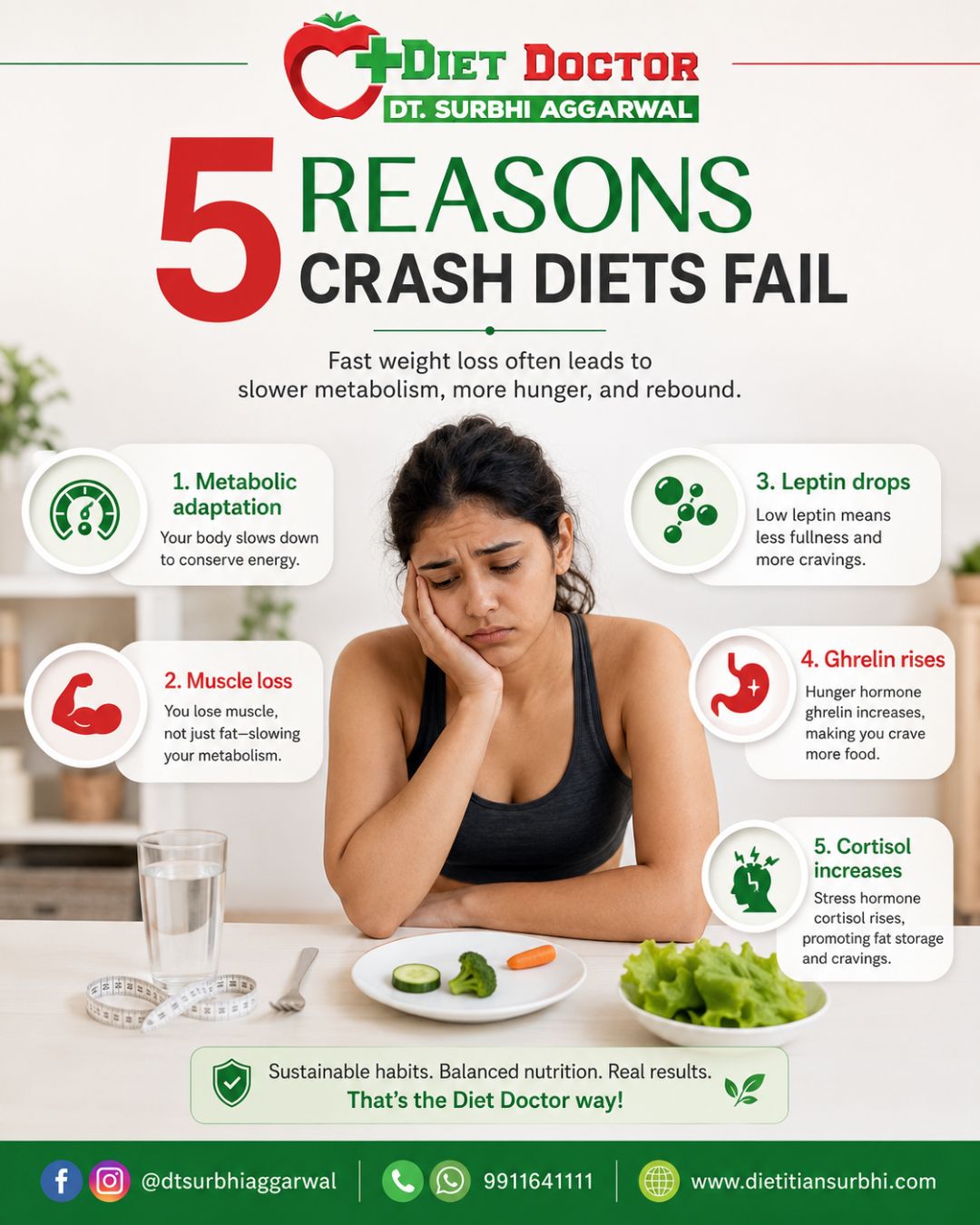
The 5 Biological Mechanisms Behind Every Crash Diet Failure
-
Metabolic adaptation — your body learns to survive on less
As described above, the body responds to prolonged calorie restriction by reducing its basal metabolic rate (the number of calories burned at rest, which accounts for 60–70% of total daily energy expenditure). This is a survival mechanism, not a defect. The body does not know you are on a diet. It responds to a sustained energy deficit the same way it would respond to a famine: by becoming more efficient. The result is that the same food that once produced a deficit now produces maintenance — or even a surplus.
-
Muscle loss — and why it makes everything worse
When calorie intake drops severely and protein is inadequate, the body turns to muscle tissue as an energy source alongside fat. Muscle is metabolically expensive — it burns more calories at rest than fat tissue does. Every kilogram of muscle mass you lose during a crash diet reduces your baseline calorie burn further, compounding the metabolic slowdown. This is one of the reasons people who cycle repeatedly through crash diets tend to find each subsequent attempt harder than the last: each cycle depletes more muscle and leaves metabolism slower.
-
Leptin crash — the satiety signal disappears
Leptin is a hormone produced by fat cells that signals fullness to the brain. When body fat decreases, leptin levels fall. The brain receives less of the “I have enough stored energy, stop eating” signal and more of the “find food urgently” signal. Research by Dr. Jeffrey Friedman’s team at Rockefeller University, who first identified leptin in the 1990s, and subsequent clinical research have consistently shown that leptin levels drop sharply during calorie restriction — and take months to normalise after weight loss, even when the restriction ends. This is biology driving hunger, not weakness.
-
Ghrelin surge — the hunger hormone ramps up
Ghrelin, produced primarily in the stomach, is the hormone most closely associated with hunger. It rises before meals and falls after eating. The same 2016 Biggest Loser study documented significantly elevated ghrelin levels in contestants long after their dramatic weight loss — meaning their bodies were chronically signalling hunger at levels higher than people who had never lost weight. The combination of falling leptin and rising ghrelin creates a hormonal environment where overeating feels almost involuntary once the restriction ends.
-
Cortisol elevation — stress hormones that promote fat storage
Severe calorie restriction is a physical stressor. The body responds by elevating cortisol — the primary stress hormone — which in sustained amounts promotes fat storage, particularly visceral (abdominal) fat, and can disrupt sleep, mood, and immune function. Clients who come to me after extended crash diets often report symptoms that align with elevated cortisol: fatigue that doesn’t resolve with rest, increased abdominal fat even though their overall weight has decreased, and a persistent feeling of being “wired but tired.” These symptoms typically improve within 4–8 weeks of returning to adequate, structured eating.
What Twelve Years of Client Patterns Actually Show
The biology above comes from published research. What I can add to it is what I have observed across thousands of client histories in Delhi NCR.
The first pattern is consistency: clients who come to me after crash diet failures almost universally report the same three-month arc described above, regardless of which specific diet they used — GM diet, keto at 900 calories, liquid-only plans, or self-designed near-starvation approaches. The mechanism is the same whether the vehicle is cabbage soup or bulletproof coffee.
The second pattern is the rebound multiplier. In my client data, people who lose weight via crash diets do not typically regain just the weight they lost. A majority regain more — often 20–30% above their starting weight — because they return to pre-diet eating patterns with a now-slower metabolism, disrupted hunger hormones, and often additional muscle lost during the restriction. The client I described at the opening lost eleven kilos and regained fourteen. This is not unusual. It is, in fact, close to typical.
The third pattern, which I find the most clinically significant, is the progressive difficulty of each attempt. Clients who have crash dieted repeatedly — sometimes 8 or 10 rounds over several years — report that each time they try to lose weight through restriction, the results are smaller and the rebound is faster. This is consistent with what the research on repeated weight cycling (the “yo-yo effect”) suggests about long-term metabolic adaptation.
How to Recover from a Crash Diet: A Starting Framework
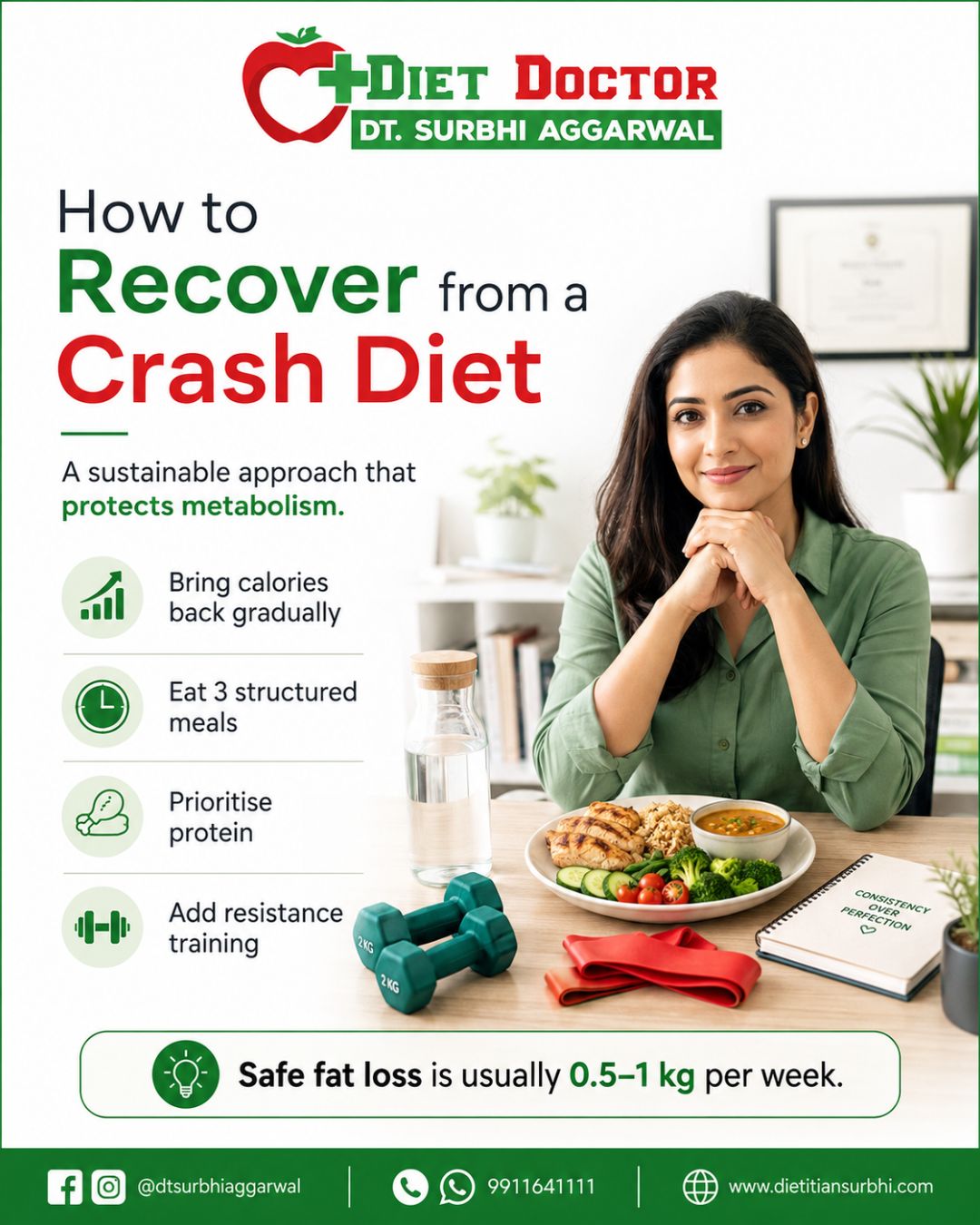
If you recognise yourself in any of the above, the goal is not to start another diet. It is to rebuild the metabolic foundation first.
| Recovery Phase | What to Do | What to Avoid |
| Week 1–2 | Bring calories back to a realistic maintenance level gradually — not all at once | Jumping to large calorie surpluses that accelerate fat regain |
| Week 3–4 | Establish three structured meals, prioritising protein at each one | Skipping meals or returning to any form of restriction |
| Month 2 onwards | Add resistance activity if cleared by a doctor — muscle rebuilding is the single best long-term metabolic intervention | Another crash diet “just to get back on track” |
| Ongoing | Work with a qualified dietitian to set a sustainable 200–400 calorie daily deficit, not 1,000+ | Any plan that requires you to stop eating foods you actually enjoy |
The sustainable rate of fat loss that does not trigger severe metabolic adaptation is generally 0.5–1 kg per week for most adults. It is slower than a crash diet. It is also the rate at which the weight stays off.
What I Do Differently
The weight-loss approach I use with clients is built on a simple principle: the plan has to work when you go to your cousin’s wedding, when your office has a Friday biryani lunch, when Holi comes with its thandai and gujiyas, and when it is 10 PM and you are exhausted. A plan that only works under controlled conditions is not a plan — it is a temporary experiment with a predictable ending.
Every personalised meal plan I build starts from current eating habits, real food preferences, and the minimum calorie level that keeps metabolism protected while still creating a sustainable deficit. No crash required. No rebound expected.
Frequently Asked Questions
Why do crash diets work initially but stop working?
The initial loss is largely water and glycogen, not fat, which produces fast scale movement. As the weeks continue, the body adapts by slowing metabolism, losing muscle, and ramping up hunger hormones — all of which progressively close the calorie gap the diet was relying on. By week 8–12, many people are eating at what is effectively maintenance for their now-slower metabolism, while feeling significantly more hungry than before the diet started.
Is it harmful to do a crash diet once?
A single short-term severe restriction is unlikely to cause permanent damage in otherwise healthy adults. The concern is the cumulative effect of repeated cycles — each round of restriction and rebound makes the next round harder and increases the risk of muscle loss, hormonal disruption, and long-term metabolic slowing. Even a single prolonged crash diet (more than 4–6 weeks) can produce measurable metabolic adaptation that takes months to reverse.
Why do I gain more weight after a crash diet than I lost?
Because the metabolism has slowed, muscle has been lost, and hunger hormones remain elevated for months after the restriction ends. When eating returns to normal — sometimes even to the pre-diet intake level — the body is now burning fewer calories and is hormonally primed to overeat. The combination reliably produces rebound weight gain above the starting point.
Can I speed up my metabolism after a crash diet?
Yes, though it takes time. The most effective interventions are progressive resistance exercise (which rebuilds muscle mass), adequate protein intake (which supports muscle synthesis), sufficient total calories to signal safety to the body, and consistent sleep — poor sleep independently worsens both leptin and ghrelin profiles. There is no supplement, food, or drink that meaningfully reverses metabolic adaptation — that claim should be treated with significant scepticism.
How long does metabolic recovery take after a crash diet?
This varies depending on how severe and prolonged the restriction was. For a 4–6 week crash diet, metabolic normalisation with structured eating and adequate protein typically occurs over 2–4 months. For clients who have spent years repeatedly crash dieting, recovery is longer and benefits significantly from a supervised, structured nutrition programme rather than a self-managed approach.
What is the safest rate of weight loss that doesn’t damage metabolism?
Research consistently points to 0.5–1 kg per week as a rate at which fat loss can occur without triggering severe metabolic adaptation or significant muscle loss, provided protein intake is adequate. This rate requires a moderate daily deficit of 300–500 calories from a realistic maintenance intake — not a dramatic cut to 800 calories.
I’ve been crash dieting for years. Is it too late to fix this?
In nearly every case I have seen clinically, no. Metabolism is remarkably adaptive in both directions. The same plasticity that allows it to slow down in response to restriction allows it to recover in response to adequate, structured nourishment. It takes longer than people want, and it requires patience with a slower weight-loss pace — but rebuilding from a crash diet history is entirely possible with the right approach.
Ready to Break the Crash Diet Cycle?
If you have been through the cycle described in this article — initial success, plateau, rebound, repeat — a personalised approach built on your actual metabolism, blood reports, and lifestyle is the only thing that produces lasting results.
Book a consultation with Dietitian Surbhi and let’s build a plan that works with your biology, not against it.
📞 Call / WhatsApp: +91-9911641111